Well guys, I did it. After years of toil and neglect, I have finally achieved what I set out to achieve— an in-text citation worthy of a screen-grab. Here it is, from the January installment of GSA Today.
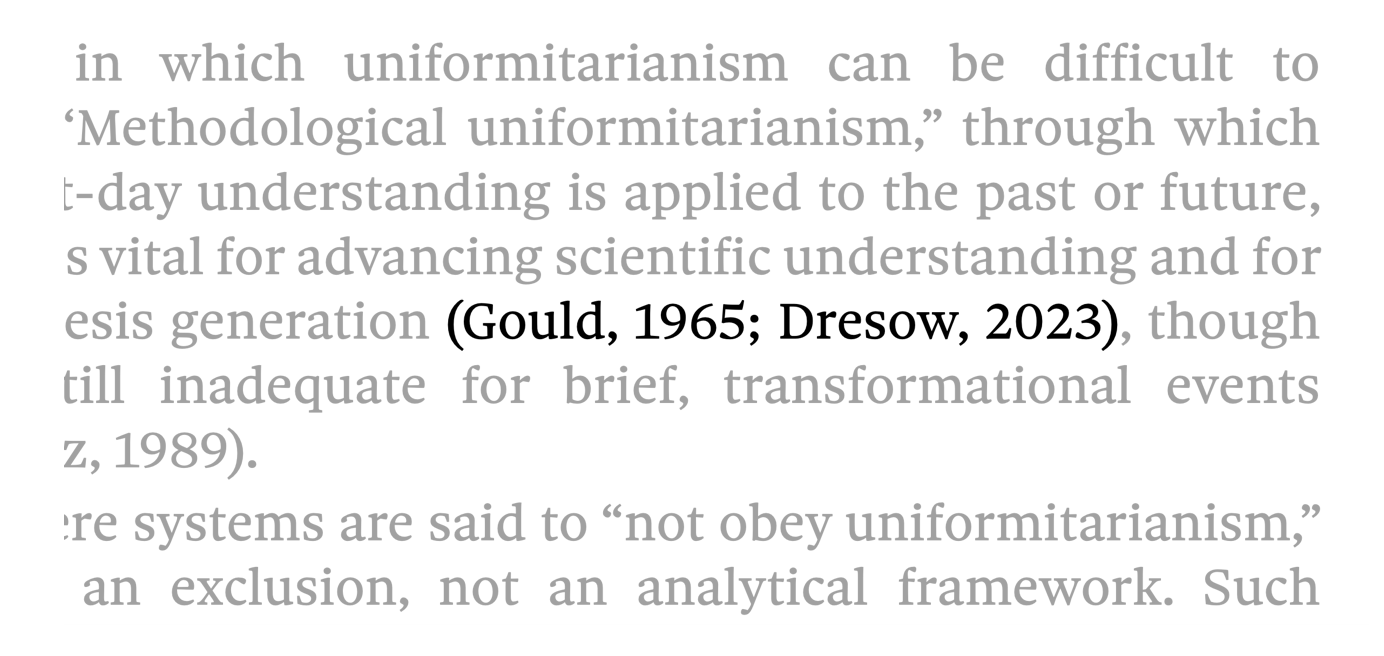
Want to learn about “methodological uniformitarianism”? I’ve got two papers you need to check out. Max and Steve. Excellent stuff. Thank you to Catherine Russell, Jürgen Renn and Jan Zalasiewicz for the shout-out.
The article, by the way, is a fun read. It’s called “Discorditarianism: A New Paradigm for Geological Interpretation,” and it aims to “crystallize the conceptual space… between process-based earth system science and evidence-based stratigraphy, such that we may more methodologically analyze uniformity and discordance in geological history.” According to the authors, discorditarianism “is a complementary, not competing, paradigm to uniformitarianism.”The term discorditarianism “offers epistemic traction and adds a structured way to identify, define, and, ideally, quantify geological discordance,” expanding “the potential for geological science to incorporate “human impact” without oversimplistically collapsing it into a homogeneous force.” Among its recommendations, the paradigm “allows for a long-needed methodological consistency in forming structured descriptions of complex phenomena formed by geological processes that range from uniformity to discordance.” It has five steps:
Determine exactly what is being compared. Consider what temporal scales or specific time horizons, landscapes, or objects are being compared and why.
Identify which elements of uniformitarianism apply. Consider similarities in process, rate, flux, event frequency, physical laws, or broader consistencies and their extent.
Describe the spatial character of the discordance. Consider its scale, patterns, and its lateral and vertical extent (e.g., local, regional, or global).
Describe the temporal character of the discordance. Consider its longevity frequency, and any changes in intensity, distribution, or impact over time.
Outline the forces that led to, and are impacted by, the discordance, and identify which have increased or decreased. Consider all forces, from a newly appeared plant species changing soil stability to a new law or socioeconomic policy that has affected landscape engineering.
To read the full paper, follow this link.