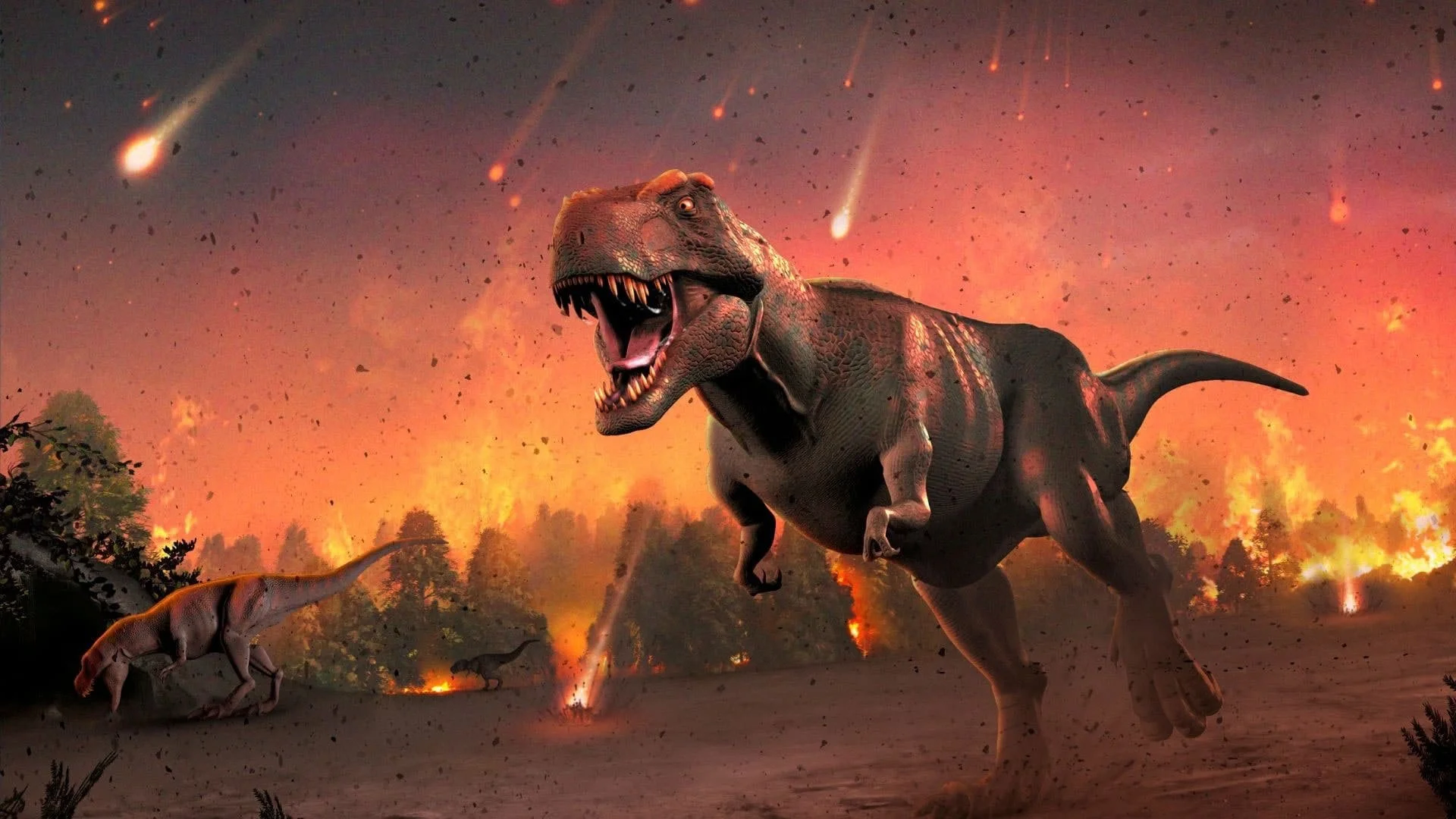
Ever since Kendrick Lamar chose violence, we’ve understood that big threes— and by extension, big fives— are open to dispute. Well folks, it’s happened again. This time it went down at the annual meeting of the Geological Society of America, and the subject was mass extinction. According to work by Shuzhong Shen and colleagues (and based on an AI model that “integrates within-section stratigraphic superposition, species co-occurrence patterns, temporal windows, and radiometric age constraints”), only two of the “big five” mass extinctions merit that title. These are the end-Ordovician and end-Permian events. The Late Devonian, end-Triassic, and end-Cretaceous extinctions, by contrast, appear as “comparably weak or diffuse” events— mid-tempo biodiversity leaks as opposed to catastrophic implosions.
James Dinneen at Nature has a nice write-up of the results. He notes that, in 2020, Shen’s group “ran an algorithmic method on a supercomputer to piece together thousands of [stratigraphic] sequences, [which enabled] them to estimate when a species appeared and went extinct with a resolution of 26,000 years.” But they also slammed into a limit. Shen and colleagues wanted to add more species to the 11,000 they were able to analyze using the supercomputer, but this required too many computational resources.
To get around that computational limit, Shen’s colleagues at the Zhejiang Lab— an artificial-intelligence-focused research institution in Hangzhou, China— used data from OneStratigraphy to train a machine-learning model on statistical patterns in the fossil record. Just as an LLM uses its training to predict the next word in a sentence, the OneStrata model uses those patterns to predict when a particular fossil is most likely to have been deposited.
The researchers then used the model to predict where nearly four million marine fossils from tens of thousands of sites fall in the rock record with a time resolution of just over 1,000 years. From this information, they could estimate at high temporal resolution the appearance and extinction of more than 110,000 species over the past 540 million years.
I am a certified AI hater. In quiet moment, I find myself longing for the world as it was just a few years ago, before AI had been obnoxiously thrust into every aspect of our lives. I honestly hate the technology; I hate how it’s assaulting the arts, how it’s devaluing the written word, how it’s giving hacks and grifters all new ways of debasing what remains of our shared culture. It just sucks, and that's before you consider the data centers and the fact that a bunch of terrible people think it’s really great. …Having said that, I think this study is kind of neat. (And before anyone calls me a hypocrite— yes, AI can be an offensive, environmentally disastrous, deeply uncool technology that also has some interesting applications. Of course it can!)
The big question, I suppose, is what to make of the results. Shen’s OneStratigraphy database includes a preponderance of high-resolution data from China, so one issue is how well these data truly represent the world ocean. They may do so quite well. As Shen and colleagues noted in an earlier study, the Chinese sections span a wide range of paleolatitudes, which doubtless increases their value as a whole-ocean proxy. But the claim remains to be validated, at least in published work (as far as I’m aware).
On a more HPS-y note, there is nothing very surprising about the “big five” mass extinctions coming in for criticism. The big five were first identified in the early 1980s, based on some datasets that now look incredibly primitive. It would be strange if they held up for all time, although I confess that it’s just as strange to see the end-Cretaceous event knocked from its pedestal (if the result holds up). Also, a recent paper by Rachel Wood’s group proposed to add an extinction to the list, at the end of Cambrian Stage 4— the “Sinsk event.” To go from a possible big six to a big two is jarring, and might even call into question some basic ideas about the workings of the earth-life system (again, if the result holds up).
Anyway, this would be a good thing for philosophers to look into. For my money there are two big questions here. First, what have Shen and colleagues produced— what is the status of their “unified probabilistic framework”? (I mean, it’s a model, but what else can we say about it?) And second, (how) does it “[open] a pathway toward a predictive digital Earth,” as the authors claim in their GSA abstract? PhD students, get to work!