* This is the forty-eighth installment of “Problematica.” It concerns some early attempts to explain “the abrupt appearance of the Cambrian fauna”— the first appearance in the fossil record of abundant and diverse animals belonging to still-living groups. (Today this is better known as the “Cambrian explosion,” but we should be careful throwing this term around, since it wasn’t coined until 1964.) Hopefully this post doesn’t feel thrown together, but if it does, I should say that it’s sourced from some discarded fragments of my current book project. Anyway, it contains material close to my heart— especially the little bit on John Ralph Nursall.
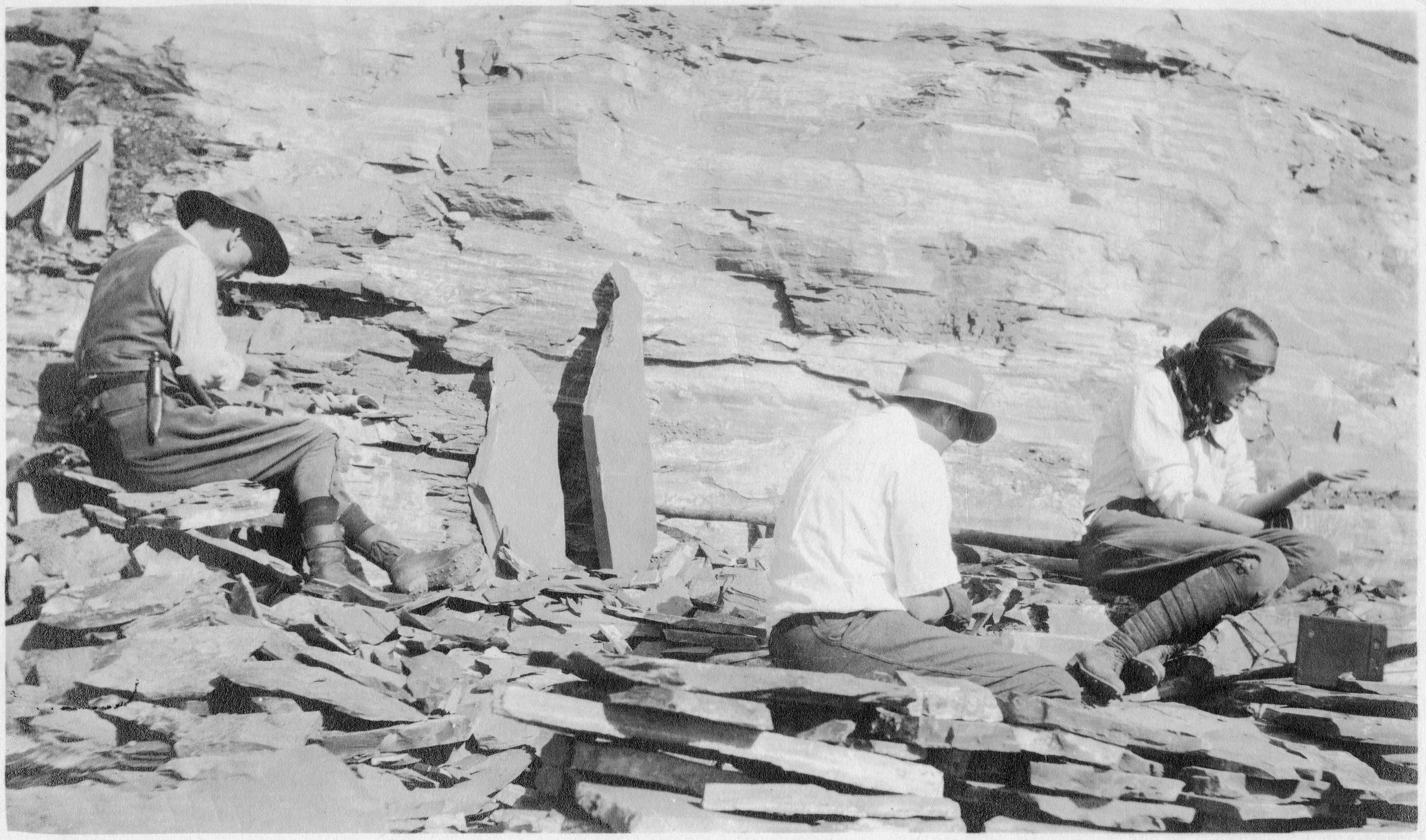
In case you’re wondering, the title image is of Charles Walcott collecting the Burgess Shale with his son Sidney and daughter Helen (1913). “Problematica” is written by Max Dresow…
In 1909, the American paleontologist Charles Doolittle Walcott discovered the Burgess Shale fauna. Rumor long held that the discovery was precipitated by a horse— usually that of Mrs. Walcott— which stumbled on a slab of rock that had tumbled down the scree slope above Burgess Pass. It now seems more likely that “the man leading the packhorse train crossed over a rock that had slid onto the trail, and Walcott, concerned that his wife’s horse might trip, moved it away” (Collins 2009). In any case, when the rock was finally split, it revealed the most stunningly preserved “phyllopod crustaceans” that Walcott had ever seen. These were later dated to the “Middle Cambrian” (today, Cambrian Stage 4), placing them just outside the blast radius of the “Cambrian explosion.”
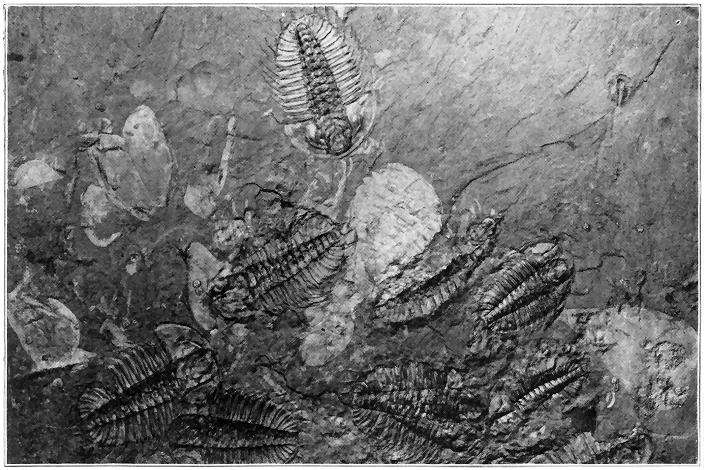
A slab of rock from the Burgess Shale, showing some trilobites jumbled up with Walcott’s “Sidney crab,” Sidneyia
The fossils of the Burgess Shale were a treasure trove. But they were too young to answer the question Walcott burned to answer— where were their ancestors? Eventually, he proposed the only solution that seemed to fit the facts. Pre-Cambrian animals thronged the seas, yet because the latest pre-Cambrian was a time of unprecedented land emergence, no marine deposits from the period currently reside above water (Walcott 1910). As for the abrupt appearance of the Cambrian fauna, this records the incursion of marine waters into the continental interior, driven by weathering and tectonics. Nothing biologically important happened around the pre-Cambrian–Cambrian boundary. There was just a change of geological conditions that permitted the formation of fossiliferous deposits in areas that now reside above sea level. It was this change that marked the beginning of the Cambrian Period.
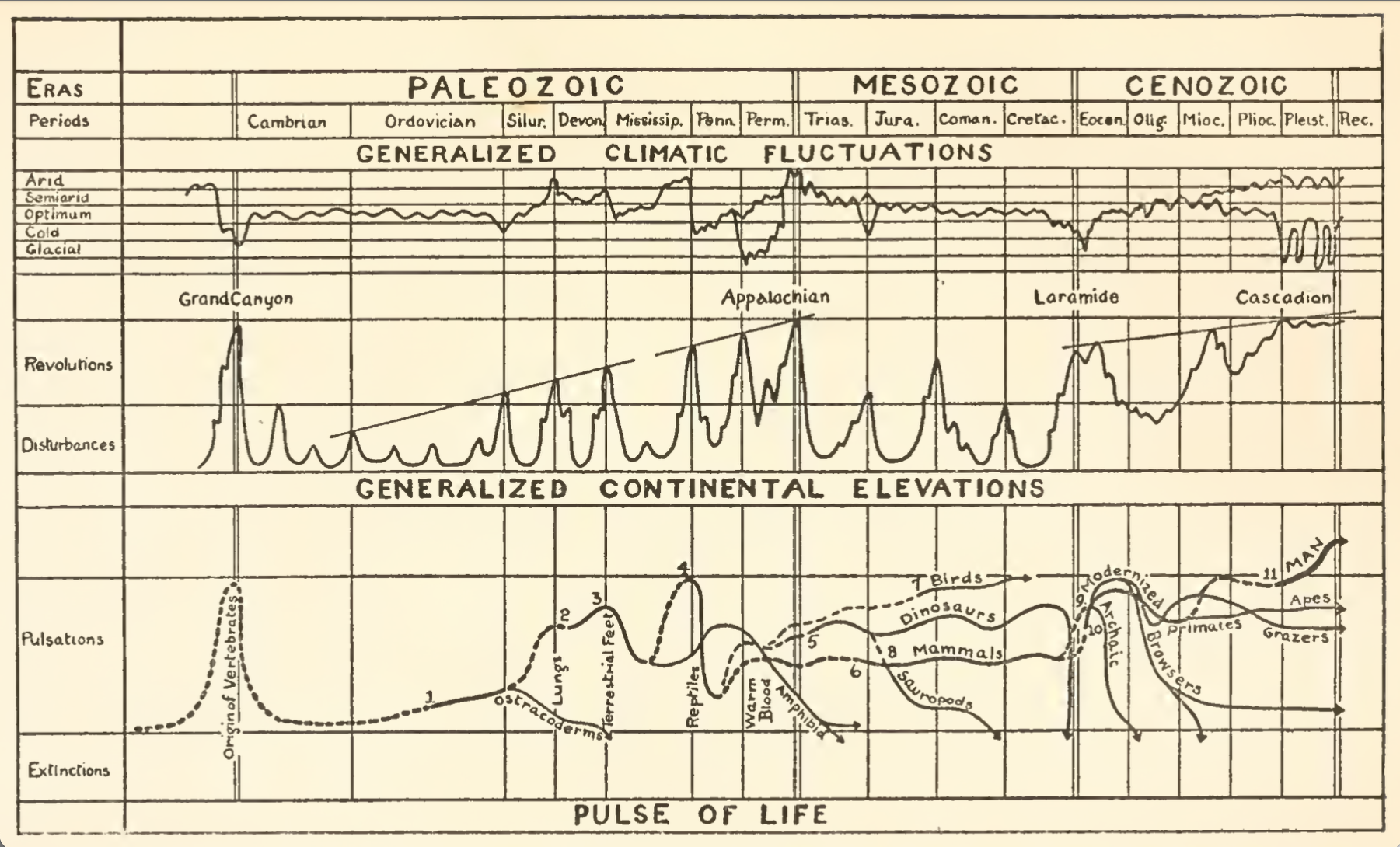
A graphic depicting the coordinated fluctuations of climate, continental elevation, and evolution, drawn by R. S. Lull, with assistance from Charles Schuchert and Joseph Barrell (1918). Note the massive elevation of land supposed to have taken place at the beginning of the Cambrian— an elevation that lent support to Walcott’s proposal that the latest pre-Cambrian was a time of extensive land emergence— the “Lipalian interval”
Opposed to this view was the model of William Brooks, which saw the abrupt appearance of Cambrian animals as an evolutionary, not a geological, event (Brooks 1895). According to Brooks, the first animals were minute swimming forms whose delicate bodies were unlikely to ever enter the fossil record. Yet when the marine fauna at last “discovered” the seafloor, a period of rapid modification ensued which saw the evolution of large size and hard, protective skeletons— a knock-on effect of another contemporary innovation, jaws. Behind this model was the idea that life at the surface of the ocean was “so easy that there [was] little fierce competition, and the inorganic environment [so] simple that there [was] little chance for diversity of habits [to evolve].” But the discovery of the seafloor introduced several new factors into the equation, which ratcheted up competition, shifted evolution into overdrive, and gave rise to the world of fossilizable animals.
Both proposals drew criticism. To Walcott’s unrecorded “Lipalian interval” it was objected that, in some parts of the world, rocks bearing the Cambrian fauna were apparently conformably underlain by bedded marine rocks lacking fossils. This meant that some lower Cambrian rocks rested directly on pre-Cambrian rocks without a gap in sedimentation that would indicate a period of land emergence. Further, the bodies of water Walcott interpreted as Lipalian lakes were “too large, too permanent, and too similar in pattern to the later [epicontinental] seas to present much evidence that they were lakes.” But if they were inland seas, then on Walcott’s view they should have been teeming with animals— and here again the fossil record was silent. As for Brooks, critics objected that he had supplied no reason for the geologically late discovery of the seafloor, nor any reason that the seafloor should have been colonized all at once by many groups of animals. With nothing to break the stalemate, a lull settled. Neither of the models seemed capable of explaining the evidence, including the seemingly abrupt appearance of animals in Cambrian times.
Other hypotheses participated in the stalemate. Perhaps the most influential came from Reginald Daly, who used an analogy with the Black Sea to explain why calcareous skeletons did not appear before the Cambrian (Daly 1907). In the Black Sea, Daly observed, the annual contribution of calcium salts from the land was greatly exceeded by the rapidity with which these salts were deposited as calcium carbonate on the seafloor. Ultimately, he put this down to anoxia. Without an oxygenated seafloor, the Black Sea lacked scavengers to prevent the decay of carcasses that rained from the surface layers to the bottom. So, as organisms died and putrefied, calcium salts accumulated on the seafloor as a kind of inert ooze, making them unavailable for animals who would otherwise incorporate them into shells. Projecting this into pre-Cambrian time, Daly imagined a sea rendered “limeless” by the absence of marine scavengers, thwarting the evolution of lime-secreting organisms. Only later, when a period of erosion flushed the sea with calcium, did the evolution of hard exoskeletons become possible— sometime during the Cambrian. And it was not until the Ordovician that conditions favoring the development of thick calcareous skeletons became widespread in the oceans.
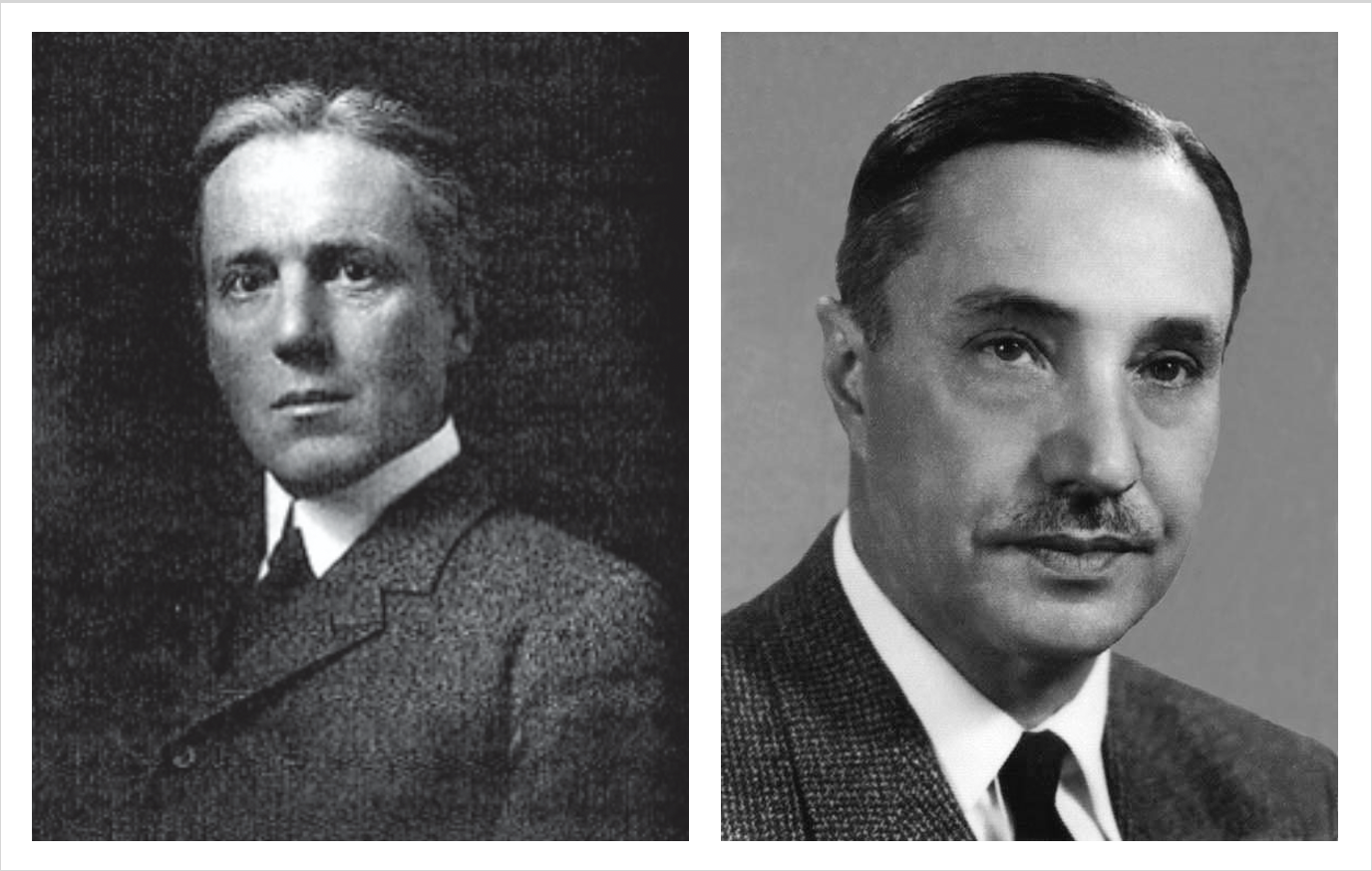
Reginald Daly (left) and Percy Raymond (right). Daly is best-remembered as an early advocate of continental drift, and as the author of a 1926 book on the subject, Our Mobile Earth. He was also one of the first to put forward an impact hypothesis for the formation of the moon. Raymond is best-remembered as the first person, apart from Walcott, to quarry the Burgess Shale. In his spare time, he collected and studied American pewters, and co-founded the Pewter Collectors Club of America
Percy Raymond was incredulous (Raymond 1947). Among his objections, he noted that animals are able to form shells “even in rivers of extremely low calcium content.” No, Brooks had been on the right track. The only problem was that— as Daly had pointed out— Brooks had little to say about why animals responded to the discovery of the seafloor by evolving hard parts. According to Daly, the innovation happened when the requisite “lime habitat” became available, sometime during the late pre-Cambrian or early Cambrian. But for Raymond, this was barking up the wrong tree. Instead of tracing the evolution of skeletons to a change in the external environment, it was better to look inside the organism, to the intimate link between activity and skeletal armor.
His own account began quaintly. Raymond noted that “the common symbols of sluggishness” in popular culture “are the turtle and the snail,” both heavily armored animals. Other creatures, like clams and brachiopods, are wholly sessile, and spend most of their lives within suits of armor. Now, it has struck many people that the presence of armor explains sluggishness, since armored animals are uniquely well-equipped to pursue a sluggish lifestyle. But for Raymond, this got things backwards. Animals acquire hard parts because they are sluggish, he argued, almost “as a pathologic condition, brought on by inactivity.” How does this work? To begin, all animals produce calcium salts, and must therefore get rid of them. “Those most active best solve the problem,” Raymond observed— they simply pee them out. But there are other options, too. You can, for example, secrete them outside the body, as many creatures did beginning in the Cambrian. That would be an attractive option for a sluggish organism that ended up on the seafloor, perhaps because it was too lazy to suffer life in the water column. Or you can forgo movement altogether and become sessile. Anyway, that was the innovation that heralded the beginning of the Cambrian— sluggishness, and all it entailed. It didn’t solve the problem of timing, but it did provide a physiological reason for the discovery of the seafloor. Some organisms were just work-shy, and after once dropping to the bottom and finding it amenable, chose to stay.
If this seems a bit far-fetched, Raymond had more useful things to say. Perhaps the most useful was that geologists “have been so much impressed by the amount of differentiation shown by the Cambrian fauna” that they have overemphasized the amount of time needed to produce it. The reason, Raymond thought, was that geologists had been “apt to think of the great phyla as absolutely distinct from one another, each higher in the scale of organization than its predecessor.” Yet to get a sense for how long it took to evolve the Cambrian fauna, it was necessary to compare the most primitive members of each phylum, not the most derived. When this was done, it emerged “that there were really only three great steps in the progress which led from the protozoans to the present great diversity of animals.” The first was the advent of simple multicellularity, in which cells retained the ability to reproduce on their own. The second was the sacrifice of cellular individuality for “complete coöperation” of the sort seen in jellyfish and corals. And the third was the evolution of a body cavity, or “coelom,” of the sort seen in “higher animals” like arthropods. Granting that a protozoan could evolve into a “coelomate” relatively quickly, there was no need to assume that the production of the Cambrian fauna required the lapse of countless ages. Perhaps, Raymond suggested, the whole thing happened relatively quickly. He summarized the argument in a diagram, which invited the reader to imagine the roughly contemporaneous origin of many groups of animals at several “grades” of organization. It was a recipe for a biological bonanza in the latest pre-Cambrian.
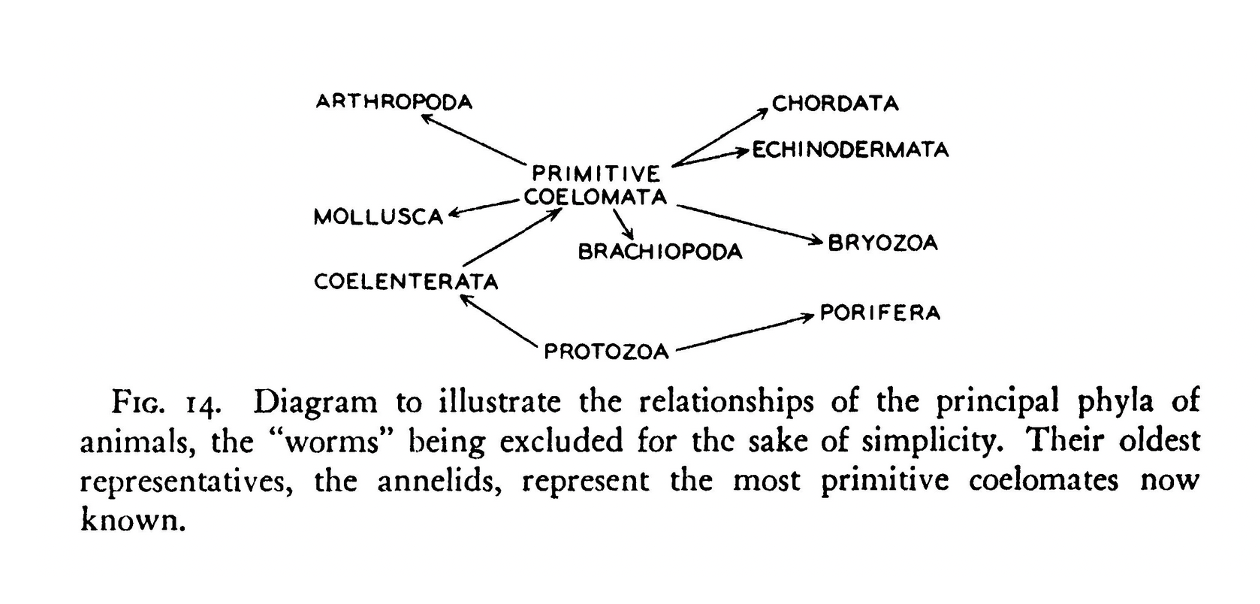
Raymond’s depiction of the evolution of major phyla, together with the original caption
* * *
Walcott, Brooks, Daly and Raymond belonged to a generation of scientists who came of age during the nineteenth century. For these scientists the dominant problem was not to explain the “Cambrian explosion”— for one thing, no such term then existed. Rather, the challenge was to explain the absence of an expected pre-Cambrian fossil record of animals. But as Brooks argued— and Raymond seems to have countenanced— rapid diversification of animals at the base of the Cambrian was a possible explanation of the pre-Cambrian fossil record. This raised a further question. Assuming the Cambrian saw a massive radiation of animals from one or a few root-stocks, what on earth could have caused that?
Throughout the 1950s, the problem attracted serious, if sporadic, attention from a wide range of figures, many of them highly eccentric. Of the resulting proposals, perhaps the most curious came from a Canadian zoologist and paleontologist named John Ralph Nursall. Writing in a 1959 issue of Nature, he argued that “the rapid diversification” of Cambrian life had a single cause: “the addition to the environment of a surplus of free oxygen.” For most of the history of the planet, the amount of free oxygen in the atmosphere had been negligible. However, as soon as oxygen became a “constant part” of the environment, around 600 million years ago, oxidative metabolism would have evolved, permitting “a variety of primitive forms” to extract more energy from their food. “The consequence of such metabolic improvement [would have been] the development of metazoan and metaphytic [multicellular plant] forms through tissue differentiation.” So, for Nursall, oxidative metabolism and multicellularity arrived simultaneously, and set the stage for the rapid establishment of all the major animal phyla.
This was a reasonable suggestion.* But in the sequel, things got weird. Several years after his Nature article, Nursall published another, this one in Evolution. There he argued that most animal phyla “arose independently from eobiont ancestors, more or less simultaneously, perhaps [after passing] through a protist stage.” By “eobiont,” Nursall meant a creature that had arisen directly from non-living components: a microbial Adam. Eobionts did not form a taxon. Instead, they were a massively polyphyletic assemblage that emerged at different times and in different places from a “panglobal biogeochemical system.” Anyway, it was from this assemblage that the animal phyla sprung, each group independently, from a separate eobiont stock. It was a vision of polyphyletic evolution that would have make Sidnie Manton blush. In Nursall’s view, evolution had created a true phylogenetic lawn, in which no blood relations existed between the major phyla. To the contrary, each group was rooted, via an eobiont stem, in the soil of a panglobal biogeochemical system, making it, in effect, a separate creation.
[* Lloyd Berkner and Lauriston Marshall would later make essentially the same argument in a paper that became much more widely known, and that introduced the term “Cambrian [evolutionary] explosion.”]
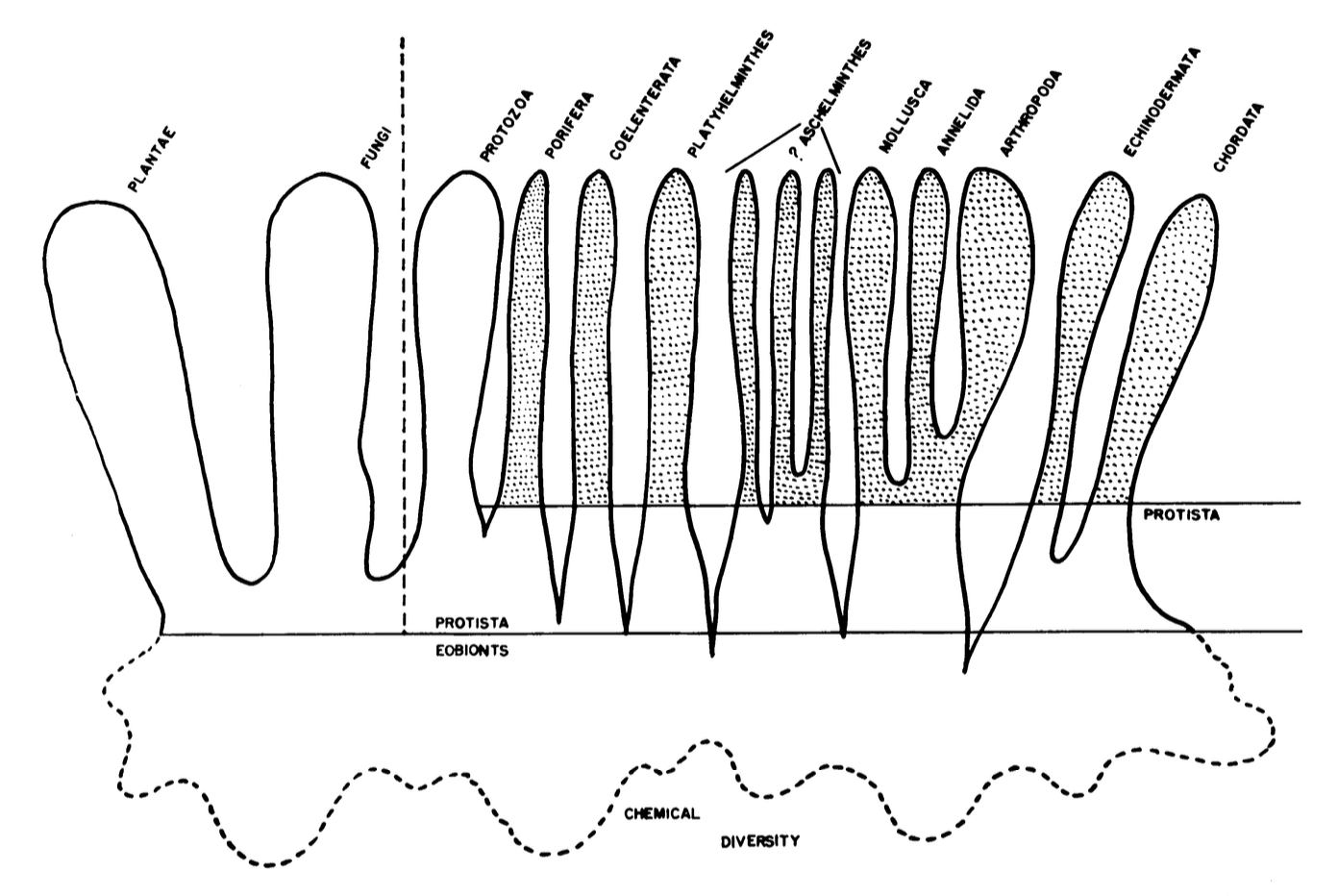
Nursall’s depiction of the evolution of major metazoan groups from a “panglobal biogeochemical system”
Around the time Nursall was formulating these ideas, a rather different proposal emerged from Berkeley, California. Its author was Daniel Axelrod— “Prof Ax” to his friends, and to motorists able to make out his vanity license plate— and it concerned the lack of “multicellular, hard-shelled organisms” in the pre-Cambrian. Axelrod began by throwing his support behind the idea that there had been an explosive radiation of animals in early Cambrian time. Yet he worried about the absence of a pre-Cambrian fossil record, since “presumably [ancestral animals] were rather widespread, to judge from the world-wide distribution of the Early Cambrian fauna.” How could the situation be accounted for?
Axelrod’s solution harkened back to Walcott’s Lipalian interval. As he explained, Walcott believed that the early Cambrian fauna evolved prior to Cambrian time, “but that no record of it was preserved because the continental platforms were [then] above sea water.” This meant that any coastal records of late pre-Cambrian life were presently drowned on the continental shelves, and therefore inaccessible. The idea was wrong: “Most investigators are now agreed that the nonfossiliferous sections which conformably underlie the earliest Cambrian faunas are largely marine, not continental, as Walcott supposed.” But perhaps, Axelrod thought, a variant of Walcott’s proposal could be salvaged. He reasoned that a coastal environment “would almost certainly have been ideal for Precambrian marine invertebrates.” The water would have been warm, the nutrient supply continuous, the plankton population ample. “Local variations in topography [and] bottom type… would [have] resulted in a wide array of ecologic niches”— perfect conditions for explosive evolution. And yet “we could scarcely expect much of a record of any fossils that may have been present,” since “the hinge line between land and sea is not broad and is eroded as soon as the area is only slightly elevated.” Further, if evolution was “progressing chiefly in the warmer parts of a broad tropical zone, the area in which fossils might have been preserved through the vicissitudes of more than 550 million years of earth history” would be further reduced.
Axelrod concluded that records of pre-Cambrian life were likely to be scarce, but not vanishingly so. Probably some existed, and paleontologists should make every effort to locate them. In doing this, however, they should remember that “the more primitive members of phyletic stocks” were probably miniscule compared to their descendants. Axelrod mentioned “the remarkable living relict” Hutchinsoniella, which grew to just three centimeters long. Pre-Cambrian animals may have been even smaller, which meant that the greatest care would be required if anyone was going to have even the remotest chance of finding them.
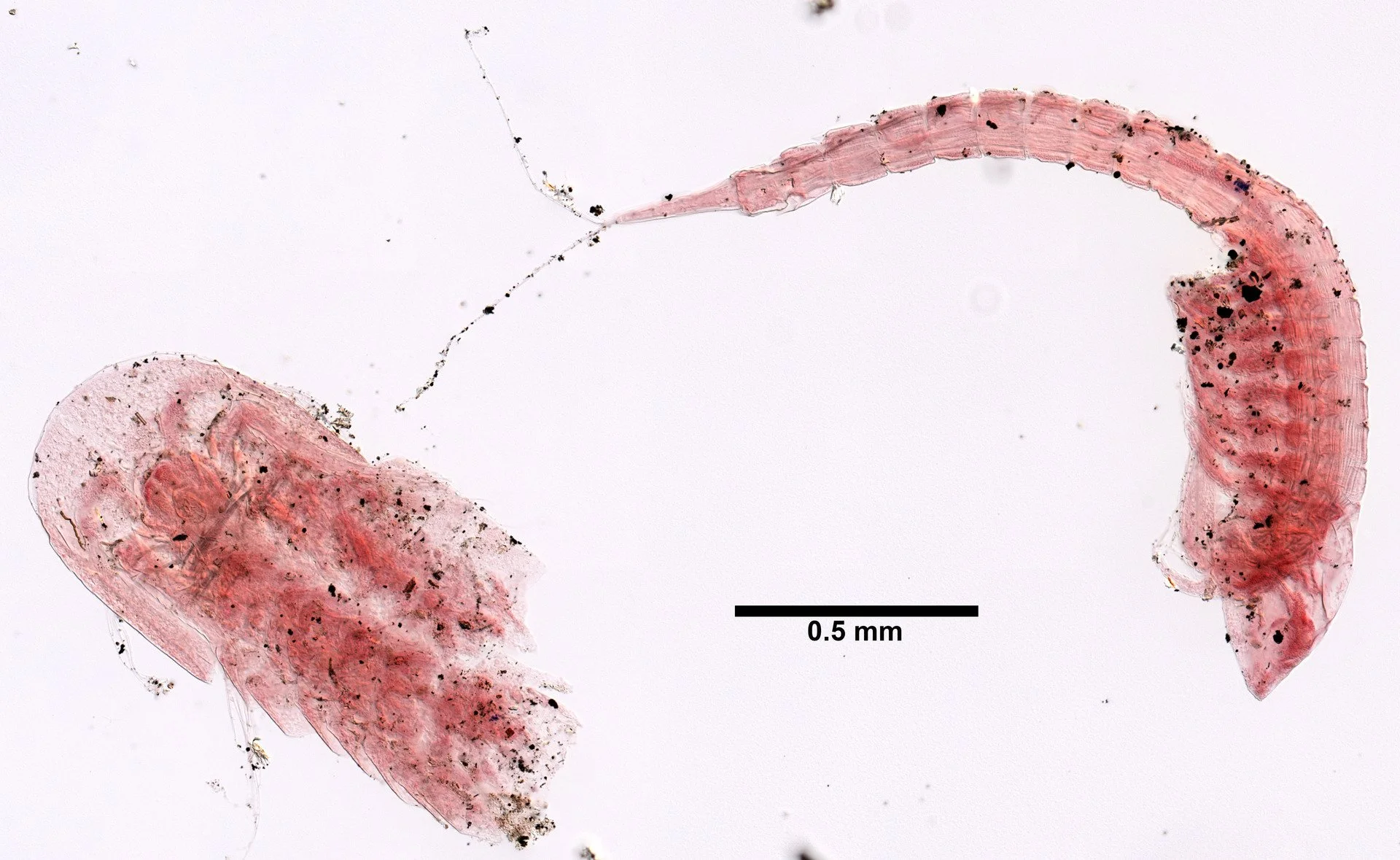
Hutchinsoniella— for Axelrod, a model for understanding late pre-Cambrian animal life
While Axelrod self-consciously invoked Walcott’s Lipalian interval, it’s noteworthy that he also endorsed an explosive evolution scenario for the origin of metazoans. That put him (and Nursall) in rare company. As Preston Cloud wrote in 1972, most paleontologists at the time did not regard the “Cambrian evolutionary explosion” as a historical reality. To do this, they would have had to accept that most metazoan phyla originated in a great burst at the beginning of the Cambrian. And yet there was another option, which was to assert that the Cambrian radiation had been preceded by a long period of cryptic diversification, during which time the distinctive features of animal groups had been slowly evolved. That continued to strike many as the more reasonable hypothesis, despite the lack of evidence to support it. So, for example, Alfred Fischer (1965) speculated that some animal groups might predate the Cambrian by half a billion years or more, having long bided their time in isolated nurseries before radiating into the open ocean (and the fossil record).
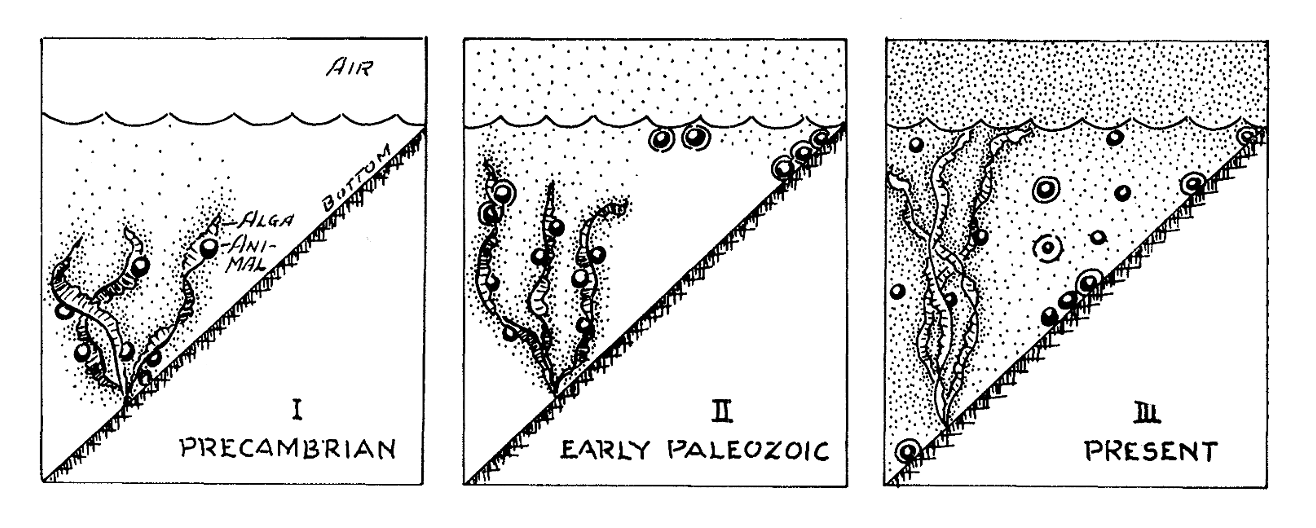
Fischer’s model of animal evolution, with animals drawn as small balls and oxygen levels depicted with stippling
Fischer also had a strong allergy to explosive evolution, which he associated not with Nursall or Cloud, but with the German paleontologist Otto Schindewolf. In 1956, Schindewolf had argued that the sudden appearance of modern phyla had resulted from a series of Grossmutations, or mutations of large effect, perhaps stemming from a period of heightened cosmic radiation. American scientists had long been resistant to such proposals, even when they came from famous German scientists. They were too idealistic, too catastrophic, too un-Darwinian. Anyway, Schindewolf’s authority in his home country did nothing to advance the cause of explosive evolution in the United States. Quite the contrary— the association of evolutionary explosions with Schindewolf’s cyclical, internalist theory of evolution was a hindrance outside of Germany, and one that would not loosen its grip until after Schindewolf’s death in 1971.
* * *
The 1970s were a key decade for research into the Cambrian explosion. Not only did they see the flowering of the Harry Whittington-led revision of the Burgess Shale fauna, but they also saw several attempts to apply the new methods and sensibilities of the paleobiology movement to the Cambrian phenomenon. These are beyond the scope of this post, but I’ve written about them here, for example, and here. And if you’re the patient type, you might consider waiting for my book, which will appear— eventually.
Anyway, that’s all for now. But keep a lookout for more Cambrian content from Extinct, coming soon…
References
Axelrod, D. I. “Early Cambrian marine faunas,” Science 128 (1958), 7–9.
Brooks, W. K. “The origin of the oldest fossils and the discovery of the seafloor,” Johns Hopkins University Circulars 14 (1895), 11–16.
Cloud, P. E. “A working model of the primitive earth.” American Journal of Science 272 (1972), 537–548.
Collins, D. “Misadventures in the Burgess Shale.” Nature 460 (2009), 952–953.
Daly, R. A. “The limeless ocean of Precambrian time.” American Journal of Science 23 (1907), 93–115.
Fischer, A. G. “Fossils, early life, and atmospheric history,” Proceedings of the National Academy of Sciences, United States of America 53 (1965), 1205–1213.
Nursall, J. R. “On the origins of the major groups of animals,” Evolution 16 (1962), 118–123.
Nursall, J. R. “Oxygen as a prerequisite to the origin of the Metazoa,” Nature 183 (1959), 1170–1172
Raymond, P. E. Prehistoric life (Cambridge: Harvard University Press, 1947).
Schindewolf, O. “Über präkambrische Fossilien,” in F. Lotze, ed., Geotektonisches Symposium zu Ehren von Hans Stille (Stuttgart: Ferd. Enke, 1956), 455–480.
Walcott, C. D. “Abrupt appearance of the Cambrian fauna on the North American continent,” Smithsonian Miscellaneous Collections 57 (1910), 1–16.