* This is a special mini-installment of “Problematica.” It’s about something we’ve discussed before on “Extinct,” believe it or not— geopoetry. (Also, this weird thing I wrote about Goethe.) Problematica is written by Max Dresow…
I found something that I need to share with you. Not because it’s good. Because it’s interesting, I suppose. And bad. Really, very bad.
Understandably, uniformitarianism has not been the subject of a great deal of poetry. To find out why, I give you Karl P. Schmidt— a herpetologist who died a herpetologist’s death: killed by the bite of a boomslang snake, which struck him in his office, after which he recorded the effects of the venom in his diary. (Schmidt has popped up one other time on Extinct, as an example of how the followers of W. D. Matthew’s biogeography could be openly racist.)
Anyway, here is the poem. It comes from The Scientific Monthly, Volume 59, published in 1944, and is called, simply, “Uniformitarianism.”
Earth’s forces fill the mind with awe:
Volcanic burst and earthquake shock,
The glaciers grinding tons of ice,
The hurricane and river’s flood,
Mountain bared by avalanche,
And every great catastrophe.Yet in the end far mightier
Are raindrop, snow, and rivulet,
With alternating sun and frost —
Faint forces, multiplied by Time.That mountains only slowly rise.
And wear away to level plain
With only causes commonplace
As those that lie before our eyes,
The simple doctrine, understood,
Opens a vista to eternal time.
Woof.
Look— everyone knows that Cuvier stans own geopoetry. There’s just a lot more to work with. I mean, the stuff basically writes itself.
Shelley, show these dorks how it’s done:
All things that move and breathe with toil and sound
Are born and die; revolve, subside, and swell.
Power dwells apart in its tranquility,
Remote, serene, and inaccessible:
And this, the naked countenance of earth,
On which I gaze, even these primaeval mountains
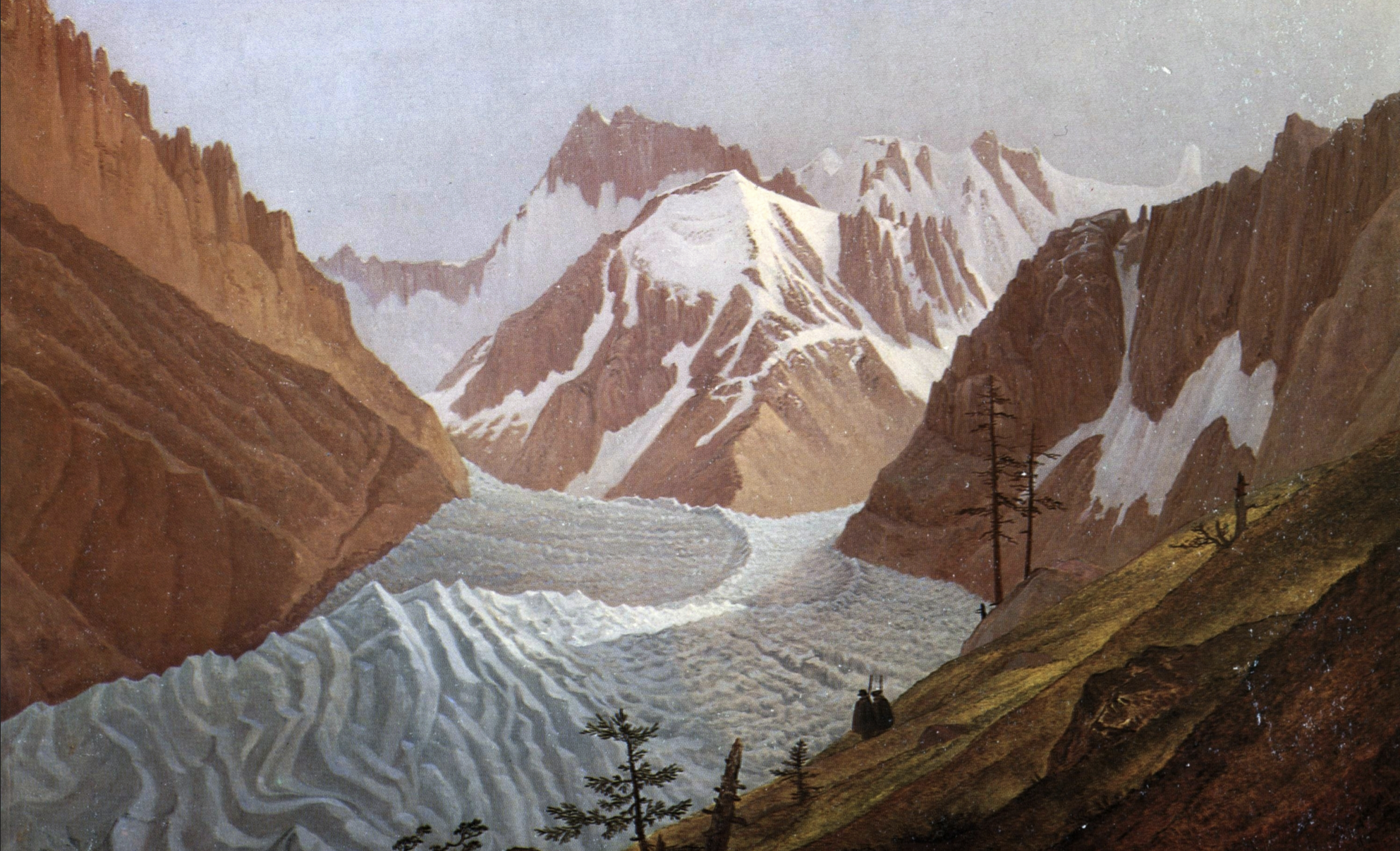
Teach the adverting mind. The glaciers creep
Like snakes that watch their prey, from their far fountains,
Slow rolling on; there, many a precipice,
Frost and the Sun in scorn of mortal power
Have piled: dome, pyramid, and pinnacle,
A city of death, distinct with many a tower
And wall impregnable of beaming ice.
Yet not a city, but a flood of ruin
Is there, that from the boundaries of the sky
Rolls its perpetual stream; vast pines are strewing
Its destined path, or in the mangled soil
Branchless and shattered stand; the rocks, thrown down
From yon remotest waste, have overthrown
The limits of the dead and living world,
Never to be reclaimed. The dwelling place
Of insects, beasts, and birds, becomes its spoil
Their food and their retreat for ever gone,
So much of life and joy is lost. The race
Of man flies far in dread; his work and dwelling
Vanish, like smoke before the tempest’s stream,
And their place is not known. Below, vast caves
Shine in the rushing torrents’ restless gleam,
Which from those secret chasms in tumult welling
Meet in the vale, and one majestic River,
The breath and blood of distant lands, for ever
Rolls its loud waters to the ocean-waves,
Breathes its swift vapours to the circling air.
Yep.