* This is the latest installment of “Problematica.” It is written by Max Dresow…
I recently had the pleasure of reading Jonathan Watts’s biography of James Lovelock: The Many Lives of James Lovelock: Science, Secrets and the Gaia Theory. If you’re at all interested, you should check it out. The book is warm and personal. Watts spent a great deal of time with Lovelock, and loving renders his many positive qualities. Yet the book also revels in Lovelock’s contradictions— an incorrigible bomb-maker who became the longest serving member of the British secret service; a Quaker who reveled in the military-industrial complex; a (nearly) lifelong believer in the benevolence of industry, who was nonetheless responsible for much early data on atmospheric pollution; a maverick who was almost comically susceptible to flattery, and totally without guile.
The book has some incredible nuggets. Perhaps my favorite had to do with Margaret Thatcher, who evidently loved the Gaia hypothesis. (Um, wut.) Then there’s stories about Lovelock’s time in Northern Ireland; revelations about his research for the Shell Corporation; and a remarkable portrait of his relationship with his mother. But I want to talk about something else. This is the woman I’m now convinced did even more than Lovelock to lay the foundation of the Gaia hypothesis— the “systems analyst” Dian Hitchcock.
There is a salacious side to the story, because Lovelock and Hitchcock weren’t merely colleagues at NASA’s Jet Propulsion Laboratory. They were also lovers. Evidently, it was more than a fling— Lovelock later confessed that he loved Hitchcock, although he never told her so and left her jilted. (Lovelock was married at the time, and seems to have first disclosed his love for Hitchcock in an interview with Watts, given after his one-hundredth birthday.) Anyway, this is not what I want to talk about here. For those who want the scoop, Watts has a piece in The Guardian from 2024, which is an edited extract from the book.
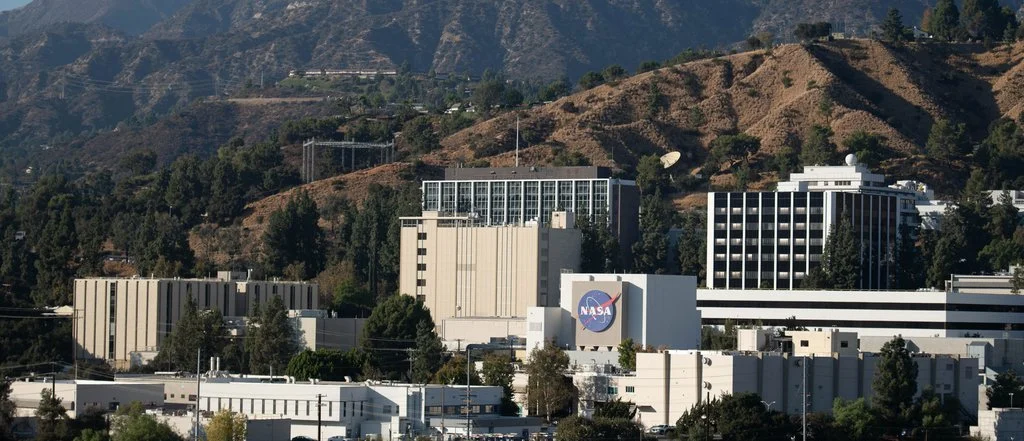
Jet Propulsion Laboratory, in La Cañada Flintridge, California
No, what I want to talk about is a letter Hitchcock wrote to Lovelock in 1966, describing the results of their joint labors.
We started our search for the unmistakable physical signature of the terrestrial biota, believing that if we found it, it would— like all other effects of biological entities— be recognisable as such by virtue of the fact that it represents ‘information’ in the pure and simple sense of a state of affairs which is enormously improbably on non-biological grounds… We picked the atmosphere as the most likely residence of the signature, on the grounds that the chemical interactions with atmospheres are probably characteristic of all biotas. We then tried to find something in our atmosphere which would, for example, tell a good Martian chemist that life exists here. We made false starts because we foolishly looked for one give-away component. There are none. Came the dawn and we saw that the total atmospheric mixture is a peculiar one which is in fact so information-full that it is improbable. And so forth. And now we tend to view the atmosphere almost as something itself alive, because it is the product of the biota, and an essential channel by which elements of the great living animal communicate— it is indeed the milieu internal which is maintained by the biota as a while for the well-being of its components. This is getting too long. Hope it helps. Will write again soon.
Now, this is a remarkable letter. It is, Watts writes, “astonishingly prescient and poignant,” given the future public development of the Gaia hypothesis. “Their view of the atmosphere ‘almost as something alive’ was to become a pillar of the Gaia theory.” Likewise, “the connection between life and the atmosphere, which was only intuited here, would be firmly established by [later] climatologists [including Lovelock].”
All true— and yet Watts neglects to highlight what I see as the most remarkable part of the letter. This is the idea that the atmosphere— “the milieu internal [sic]” of the “great living animal”— is “maintained by the biota for the well-being of its components.” No idea is more fundamentally Gaian than the idea that life maintains planetary conditions for the sake of life itself. Without this, “Gaia” is just a statement about the scale of biotic influence on the environment. But Gaia is about more than scale. It is about function, or at least recursive effect. Life acts so as to keep the planet habitable for life. Hence, when we ask that great question— why has life on earth persisted for perhaps four billion years, despite the slings and arrows of outrageous fortune, and notwithstanding a ca. 30% intensification in the supply of solar radiation? —part of the answer must be that life has created the conditions for its own thriving. That, anyway, is the Gaian answer, and Dian Hitchcock realized it, perhaps even more than Lovelock, during the 1960s.
The Gaia hypothesis is forever associated with the name James Lovelock. It is also associated with the name Lynn Margulis, and for good reason. As Watts puts it, Margulis made “an essential contribution to the Gaia theory, providing a bottom-up explanation of how Lovelock’s top-down theory might work in practice.” Yet the name Gaia should be just as firmly associated with Dian Hitchcock, who discerned, with great clarity, the Gaian solution to the habitability puzzle. In a different world, she might have carried the idea forward, and established herself as a leading thinker in the field of theoretical biology. Instead, she suffered the fate of many assertive women in a sexist society, and became a footnote.