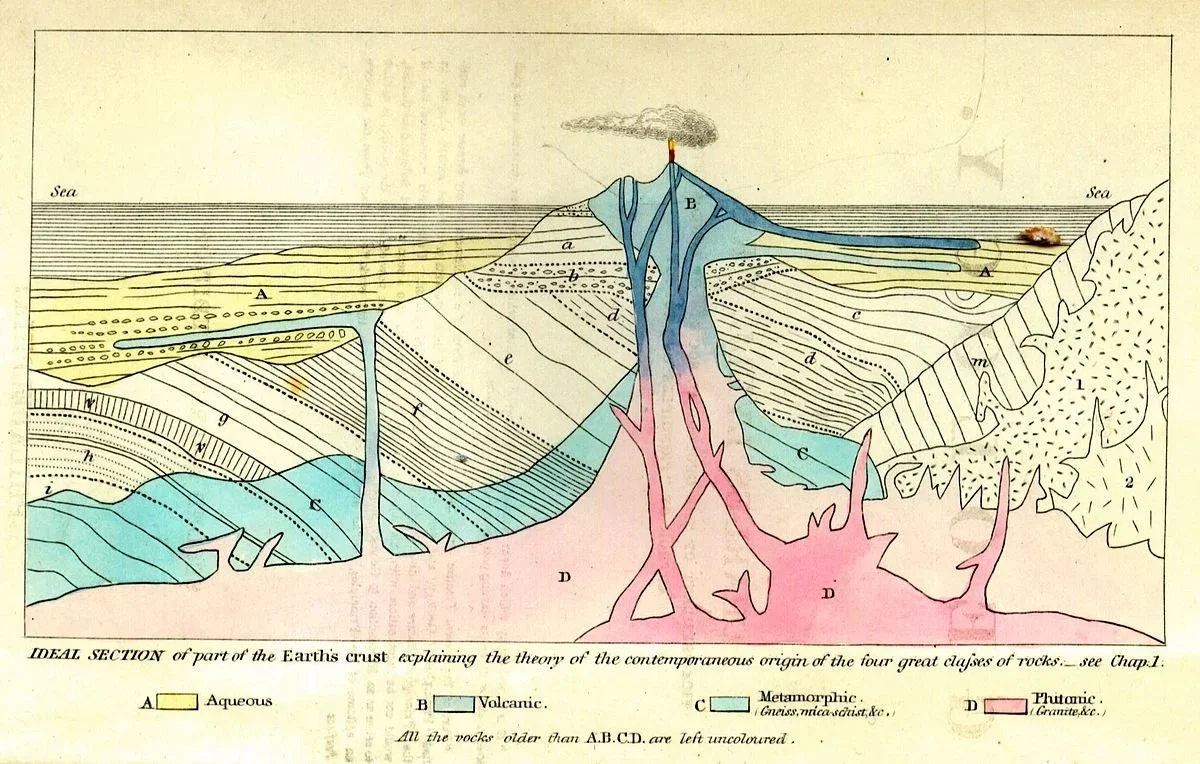
There is a new paper out in HPLS, by the talented Bogdana Stamenković Jajčević. I had the pleasure of reviewing it, and it concerns Extinct fave Charles Lyell— specifically, his “theological preformationism.” Here’s the abstract:
This paper explores the role of the “Author of nature” in Charles Lyell’s uniformitarianism. I start with a brief explanation of the term “uniformitarianism” and the identification of the fundamental hypotheses of Lyell’s theory. Moving forward, I explore his idea of the balance of nature and show that Lyell believes that natural equilibrium represents a state of stability in inorganic and organic nature. As I show, the stability of inorganic nature is achieved through the alternate activity of natural – aqueous and igneous – forces, while the balance of organic nature is established via two processes: migrations of species and struggle for survival. However, the inorganic and organic natures are connected by a unilateral causal relation which enables the first to cause changes within the second. That being the case, the activity of inorganic forces can disturb the balance of organic nature and trigger modifications in the structure of organisms, leading to their evolution. Yet equilibrium can be restored through the interventions of the “Author of nature”, who, as the instrument of evolution, equips every organism with useful variations necessary for their survival. Since organic nature represents an essential part of the natural system, the “Author of nature”, through his actions, creates and preserves the balance of the whole nature. Thus, it appears that Lyell opts for a specific version of preformationism and that his uniformitarianistic worldview presupposes a significant regulative role for the omnipotent, omnipresent, and omniscient intelligent being.
As I have often argued, there is a myth abroad about Lyell— that he was, basically, a modern naturalistic scientist, even a “materialist.” Of course, there is an element of truth in this. Lyell’s Principles was naturalistic— up to a point. But only up to a point. Beyond that point, it is very much an early nineteenth century book, more at home in the Regency than the Victorian Era (as Jim Secord has argued).
But enough from me. If you want to read a defense of this claim, go read Bogdana’s paper!