* This is the fourty-ninth installment of “Problematica.” It will be a two-parter, which means, by the time I’m done, I will have written fifty of these things! Its subject is the person I consider most historically underrated paleontologist of the twentieth century— Preston Cloud, Jr. My argument is that Cloud hasn’t received his due in existing historical writings on geobiology (with the exception of some remarks made by Andy Knoll, and repeated in his new book). But you can’t tell the history of geobiology without giving Cloud a prominent role in the intellectual ferment. Give the man his damn respect!
“Problematica” is written by Max Dresow…
I recently asked a well-known paleontologist what geobiology is. “Yes,” he replied. Then he flashed a little smile.
To be clear, this person wasn’t saying “yes” to a suggestion I’d made. He was rather saying that whatever I had in mind probably counted as geobiology– the term is a broad umbrella that shades many a project. As a sociological observation, I’m sure this is right. “Geobiology” means many things to many people. But as a starting point for historical inquiry it’s next to worthless— and the history of geobiology is what I happen to be interested in. So clearly, there’s work to do.
Some facts are clear. The term “geobiology” was coined in 1934, but seems to have been little used before the 1990s. Then, suddenly, it was everywhere. As Thomas Olszewski wrote in 2001, “It has appeared repeatedly in documents concerning future directions and funding of paleontological research, in job announcements for positions at a number of prominent universities, and will even serve as the title of a new journal scheduled to appear next year.” He went on:
In 1997, the Paleontological Society published a report to the National Science Foundation entitled "Geobiology of Critical Intervals.” This research initiative was "founded on the premise that modern paleontology, in combination with fields such as geochemistry, stratigraphy, plate tectonics, and ocean and atmospheric sciences, has great potential for exploring unique natural experiments on the structure and dynamics of the coupled earth-life system." Geobiology also appeared as a heading in several places in the report of a 1997 Senckenberg World Conference entitled "Fossils and the Future: Paleontology in the 21st Century.” In 1999, the National Science Foundation sponsored a workshop on "Geobiology and the Earth Sciences in the Next Decade.” This document proposed a research agenda for paleontology focusing on biodiversity dynamics, evolutionary innovations, the role of biological systems in biogeochemical cycling, and how the biosphere responds to environmental perturbations. (Olszewski 2001, 533)
Before long, geobiology had acquired some of the trappings of disciplinarity. It had the aforementioned journal, degree programs (first at Caltech), and endowed chairs— the field was on its way up. It also had a fast-congealing internal history, which sought to establish the pedigree of its defining idea: that life has both shaped, and been shaped by, earth's environment history. The idea was an old one. Darwin appreciated it, most clearly his final book, The Formation of Vegetable Mould, Through the Action of Worms, With Observations on Their Habits. Vladimir Vernadaky, too. But it wasn’t until the second half of the twentieth century that the idea really took off, powered by theoretical ideas like the Gaia hypothesis. Then, as the twentieth century drew to a close, interest in geobiology spiked, “driven by an increasing emphasis within the Earth sciences on understanding our planetary surface, and supported by accelerating research on the microbial control of elemental cycling, the ecological diversity of microbial life,” and sundry topics in environmental chemistry (Knoll et al. 2012, 1).
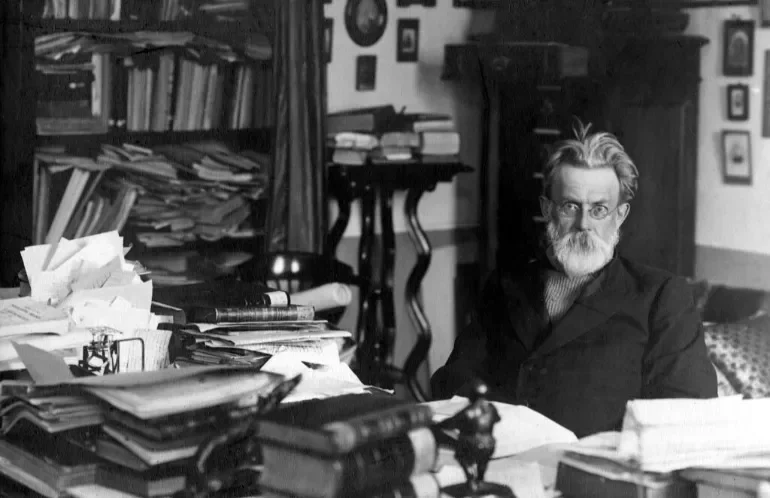
Vladimir Vernadsky, looking the part of a Russian intellectual
Without a doubt, however, the single most important factor in the emergence of geobiology was the discovery of abundant pre-Cambrian microfossils beginning in the 1950s. Prior to this, the record of pre-Cambrian life was modest. Many (potential fossils) were called but few (actual fossils) were chosen. Anyway, the revelation of a rich pre-Cambrian microfossil record changed all this. It was “a sea change,” Sophia Roosth has written, as scientists around the world realized that “[pre-Cambrian] life was thickly salted beneath our feet.” What followed was a “Precambrian land rush”:
The first laboratory dedicated exclusively to geobiology (the Baas Becking Geobiology Laboratory) was established in Canberra, Australia in 1965… During this time, a handful of laboratories in the United States and abroad were working in part on Precambrian fossils. In the U.S., these were populated largely by the students of Elso Barghoorn and Preston Cloud, including Stanley Awramik, William Schopf, and Andrew Knoll (though many of these students would teach in geology departments and variably identify as paleontologists, paleobotanists, paleobiologists, or “biogeologists”). Papers on Precambrian fossils and paleoenvironments published during these years appeared in a range of journals devoted to paleobiology, paleontology, Precambrian research, and geochemistry. (Roosth 2025)
So here we have the outlines of a multidisciplinary history of “geobiology.” It has its visionaries— Vernadsky, Baas Becking, Lovelock; the people who pioneered geobiological ways of thinking decades before these ways of thinking became widespread. It has its pioneers— Barghorn, Cloud, Stanley Tyler; the founders of paleomicrobiology, and the mentors of a new generation of students, including Knoll, Awraik, and Schopf. It has its Big Idea— that life has both shaped, and been shaped by, the evolution of earth’s surface environments. And it has its milestones— the discovery of the Gunflint microbiota in the 1950s, the establishment of the first geobiological laboratories in the 1960s, and the consolidation of “geobiology” as a disciplinary label in the 1990s, to name just a few.
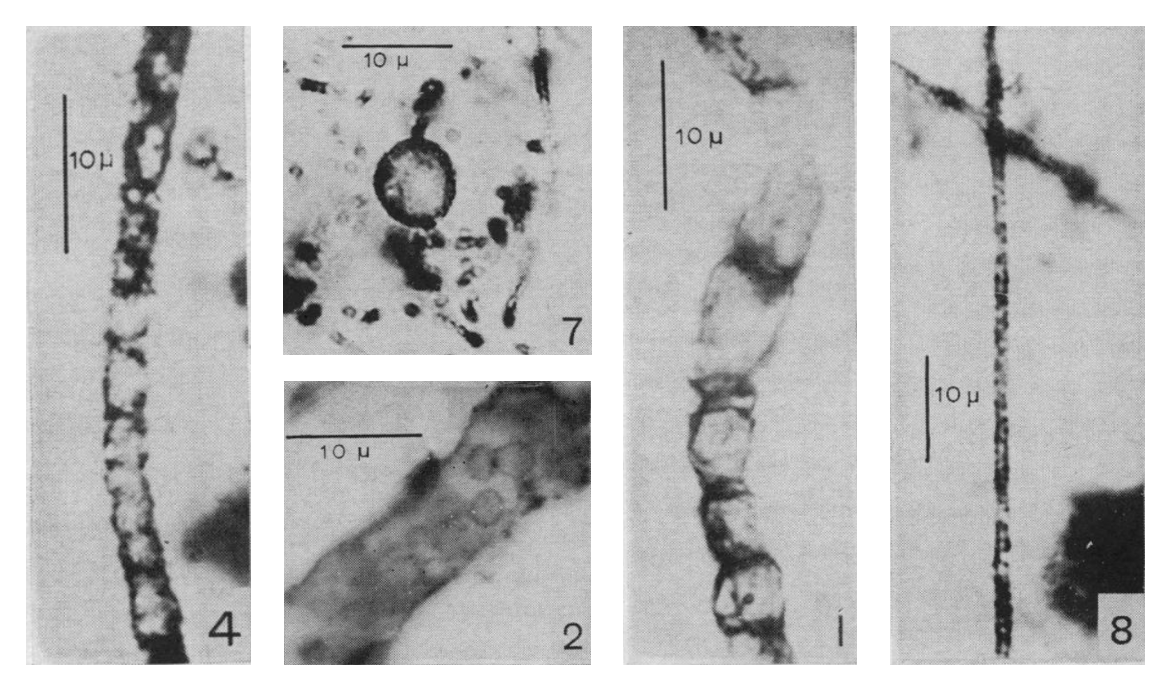
A selection of microfossils from the pre-Cambrian Gunflint Chert, photographed in thin section (from Barghorn and Tyler 1965)
All this makes for a promising start. However, because it’s early days— and because the history of geobiology has so far attracted very little attention from science historians— our narratives of the field are bound to be incomplete— assigning too much weight to this person or that event while neglecting something else. Here I argue that existing histories of geobiology err in treating geobiology as an outgrowth of paleomicrobiology, on the one hand, and of visionary speculation about the coevolution of the planet and the biosphere on the other. What is missing is an appreciation of the role played by a multidisciplinary interest in the events and conditions preceding the appearance of animals, at least in the 1950s and 1960s. So, while animals would eventually recede from prominence in geobiological research, mostly owing to the scant fossil record of pre-Cambrian metazoans, it is wrong to think that geobiology is microbes all the way down.
This probably strikes you as a modest point, and in a way it is. Still, it has a big payoff, which is to establish a new context for early interest in “geobiology,” especially in the 1950s and '60s, when the field was first coming together. The interest found expression in numerous conferences and symposia, which became a seedbed for new forms of collaboration and exchange. All the while, an ambition was taking shape— to understand the planet as a whole, even in the deepest stretches of time. It led to nothing less than a comprehensive reimagining of the pre-Cambrian interval, comprising some 85% of earth’s history. And at the center of it all was one of the most remarkable paleontologists of the twentieth century, Preston Cloud, Jr.
* * *
Previous histories of geobiology have noticed Preston Cloud, as one of the first people to describe unambiguous pre-Cambrian microfossils, in 1965. But none has quite appreciated what a crucial figure he was. He did not invent geobiology— to say that would be to miss characterize the nature of his influence. But it is perhaps not too much to say, as Andy Knoll has, that Cloud “establish[ed] the very way in which [geobiologists] think about early evolution.”
He insisted that traditional paleontology be married to geology and geochemistry so that early biological history can be understood in the context of the developing planetary surface. This powerful vision established the essential research agenda of the field. (Knoll 1990, vii)
Preston Cloud was born in 1911 in Massachusetts, and grew up in Pennsylvania. A childhood mineral collector, he spent his first years out of high school in the U.S. Navy, where he distinguished himself as the bantamweight boxing champion of the Pacific Scouting Force. (His one-time prowess as a boxer surprised none of his later colleagues, who all knew Cloud as a fighter, and as a somewhat terrifying person.) After discharge, he put himself through college by working almost full-time at the U.S. National Museum, where he served as an assistant to the brachiopod specialist G. Arthur Cooper. Cooper subsequently arranged for Cloud to attend Yale, where he completed a dissertation on the classification of terebratulid brachiopods under the supervision of Carl Dunbar. From there it was on to the U.S. Geological Survey, and thence to Harvard, where he wrote his first classic paper in 1948: “Some problems and patterns of evolution exemplified by fossil invertebrates.”
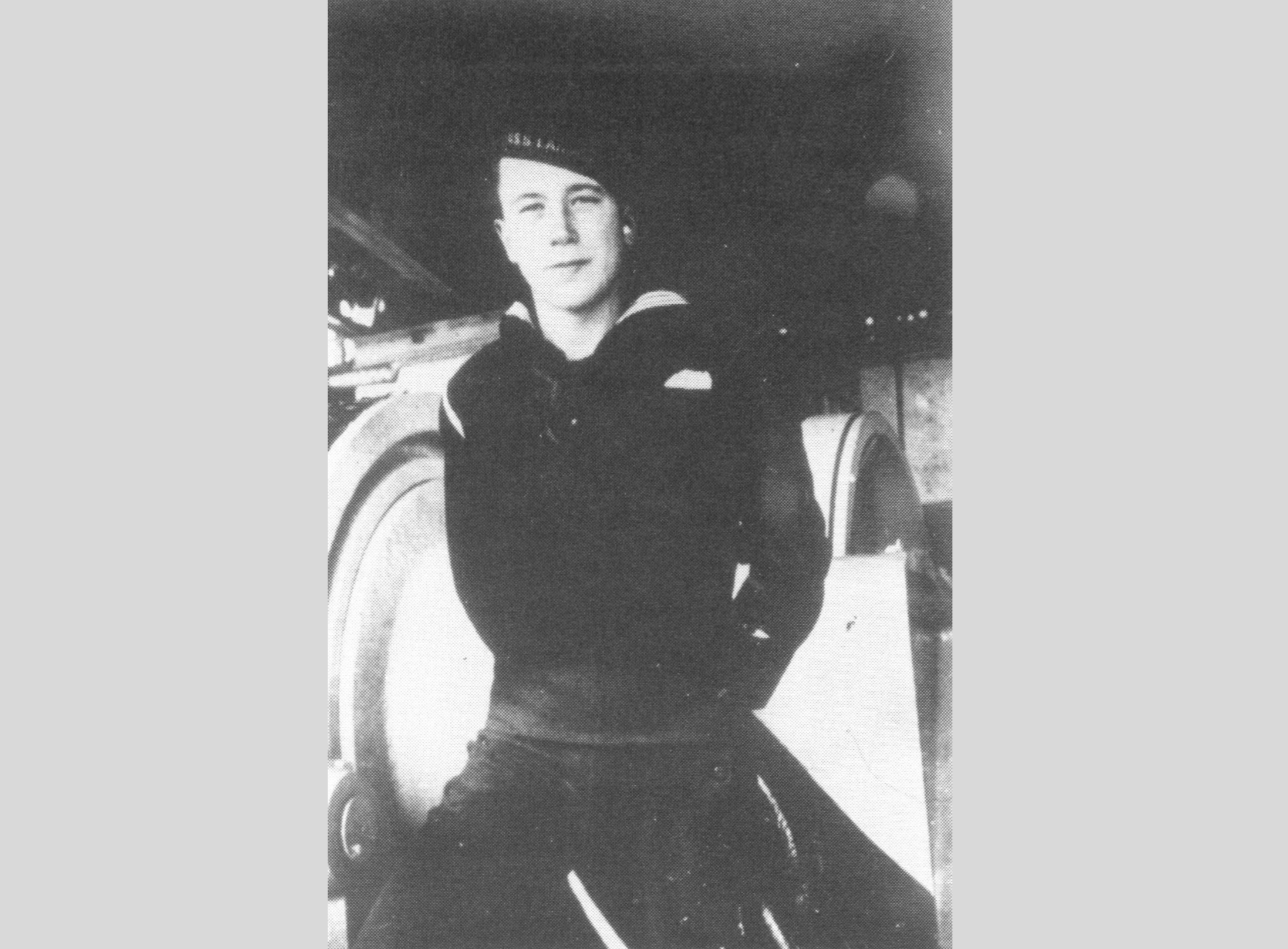
Preston Cloud during his time in the U.S. Navy
Surprisingly, no one before Cloud had applied the concept of explosive (or as Cloud preferred to say, “eruptive”) evolution to the events of the early Cambrian. Yet Cloud did precisely that, speculating that “the diversification of the Early Cambrian faunas may [have been] in large part a matter of eruptive evolution” (Cloud 1948, 348). Presumably, there had been a history of animal life before the Cambrian, “but under the concept of eruptive development it may have been much shorter and much less extensive than is supposed in conventional theory.” This was the Cambrian explosion hypothesis, sixteen years before the physicists Berkner and Marshall would confer upon it that auspicious name.
Cloud speculated that the Cambrian “eruption” probably had a basis in the evolution of the physical environment. Still, he lamented his “lack of ability to encompass the various theoretical biochemical factors that might bear on the [question of its cause].” It was a shortcoming he would seek to address; but not before his career took a turn, which saw him depart Harvard for the U.S. Geological Survey (again), where he sunk himself into problems of marine carbonate geology. In 1953, Cloud attended a multidisciplinary conference “on biochemistry, paleoecology, and evolution,” held under the auspices of the National Academy of Sciences. There, along with talks on the origin of life, the pattern of biochemical evolution, and the role of iron in oxidative metabolism, Cloud heard a cutting-edge report on the geological history of seawater composition, courtesy of W. W. Rubey. Rubey had “amassed data about the chemical composition of present-day river and ocean waters, ancient marine deposits, and igneous rocks to ascertain whether ocean chemistry could be explained solely by rivers conveying the dissolved products of rock weathering” (Bjornerud 2019). He decided it could not. As Marcia Bjornerud explains, “Rubey was unable to account for the profusion of volatile elements and compounds found in seawater, including chlorine, its most abundant ion.” (Other “excess volatiles” included water itself, carbon dioxide, and sulfur.) “He concluded that there must be another source for some of seawater’s major constituents and that [the] source might be deep-sea ‘volcanoes, fumaroles, and hot springs.’”
An important corollary of this position was that the early atmosphere would have contained almost no free oxygen, contrary to much earlier thinking. As Rubey argued, atmospheric gasses accumulated through volcanic outgassing, and volcanic gasses contain no oxygen. It followed that current oxygen levels were achieved later in earth’s history, probably through the agency of photosynthetic microbes. Before this, the only source of free oxygen would have been the splitting of water vapor molecules by ultraviolet light. But this would have produced only a paltry amount of oxygen, constantly suppressed by reactions with other gasses, and with unoxidized iron on the planet’s surface. So, again, the primitive atmosphere would have been virtually oxygen-free (or “weakly reducing” in the lingo, partly because of the lack of free oxygen).
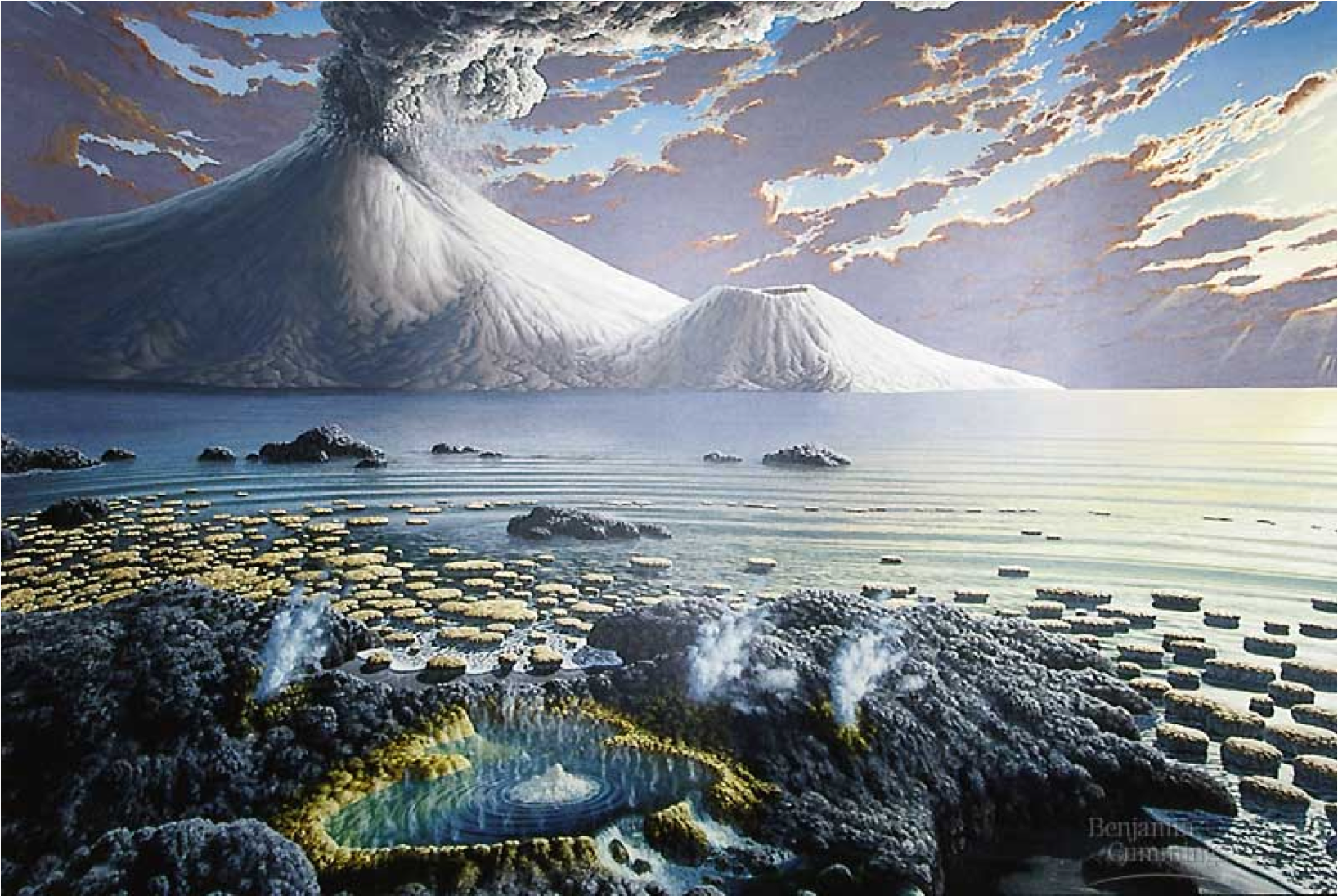
An artistic representation of the early earth, including the obligatory volcano in the distance— a reminder that the atmosphere accumulated largely via outgassing, or the release of trapped volatiles from the planet’s interior
Cloud listened and participated, as a speaker and discussion leader. He did not rush to publish his views— these were chrysalis years, in which the ferment of ideas played out in private thoughts and ruled notebooks, fed by a rich correspondence. Still they were transformative. Cloud re-joined the survey as an evolutionary paleontologist with a penchant for brachiopods. He left it as a new kind of systems-thinker, eager to seek out interdisciplinary connections and fully convinced of the value of geochemistry to illuminate the co-evolution of life and its environment.
1961 marked Cloud’s return to the academy. During his second stint with the Survey he had grown the Paleontology Division from 15 to more than 60 staff members, “enormously increased its support personnel and effectiveness,” and “initiated and organized the survey’s program in marine geology” (Rodgers 1992, 283–284). But the administrative lift had become too heavy. Eager for more research time, he accepted a position at the University of Minnesota as professor of geology, chairman of the Department of Geology and Geophysics, and head of the newly-formed School of Earth Sciences.* Almost immediately, he reoriented his research to focus on the first 85% of earth history— the “pre-Phanerozoic,” to use his preferred expression.**
[* That this was a lighter administrative burden tells you something about Cloud’s responsibilities at the U.S.G.S.]
[** Cloud was interested in the transition from the “Crytozoic” to the “Phanerozoic” phases of life’s history— in the transition from “hidden” (because small) to “visible” (large, multicellular) life. He preferred the term “pre-Phanerozoic” to “pre-Cambrian” because the latter implied that the transition from hidden to visible life happened in the Cambrian. And it might not have. (Indeed, in 1982, Cloud proposed that the first period of the Phanerozoic should be termed the “Ediacarian,” a proposal later adopted under the revised name “Ediacaran” (see Cloud and Glaessner 1982).)]
1961 was also the year of the “Woodring Conference,” which Cloud organized (with P. H. Ableson) as a follow-up to the 1953 conference on biochemistry, paleoecology, and evolution. Named for Wendell Woodring— a crucial participant in the 1953 conference— it was intended to stimulate a “new multi-disciplinary consideration of major biological innovations in the context of the geological record,” with an emphasis on “the nature, manifestations, and timing of events leading to the first Metazoa” (Cloud 1961, 1705). The event was a smashing success. Years later, Cloud would reflect that, “in effect, a new interdisciplinary subject emerged from the Woodring Conference, as people from diverse fields of paleontology, biology, geology, and chemistry sought to communicate with one another” (Cloud 1983, 21). Cloud called this discipline “biogeology.” This reflected his enduring commitment to the primacy of paleontology within the earth sciences. For all his multidisciplinary transgressions, Cloud remained forever a paleontologist, interested above all in the evolution of life on a dynamic planet— bios before geos.*
[* There is some disciplinary baggage to consider in connection with this name. Throughout the twentieth century, paleontologists had often complained that their discipline had been relegated to the status of a “handmaiden” to stratigraphy. Invertebrate paleontologists felt the subordination most acutely. As J. Brookes Knight put the point in his presidential address to the Paleontological Society: “[What] we today call a paleontologist, particularly that jellylike variety without a backbone, incapable of standing erect on his own two feet, the invertebrate paleontologist, is not a paleontologist at all. He is a geologist, a stratigraphical or “soft-rock” geologist” (Knight 1947, 284). Eventually, a group of invertebrate paleontologists would rebel against this subordination, rebranding themselves “[evolutionary] paleo-biologists” (although they also considered calling themselves “geobiologists”). Cloud was attempting a similar maneuver, while also constructing a name that fit with such existing labels as “biochemistry” and “biostratigraphy.”]
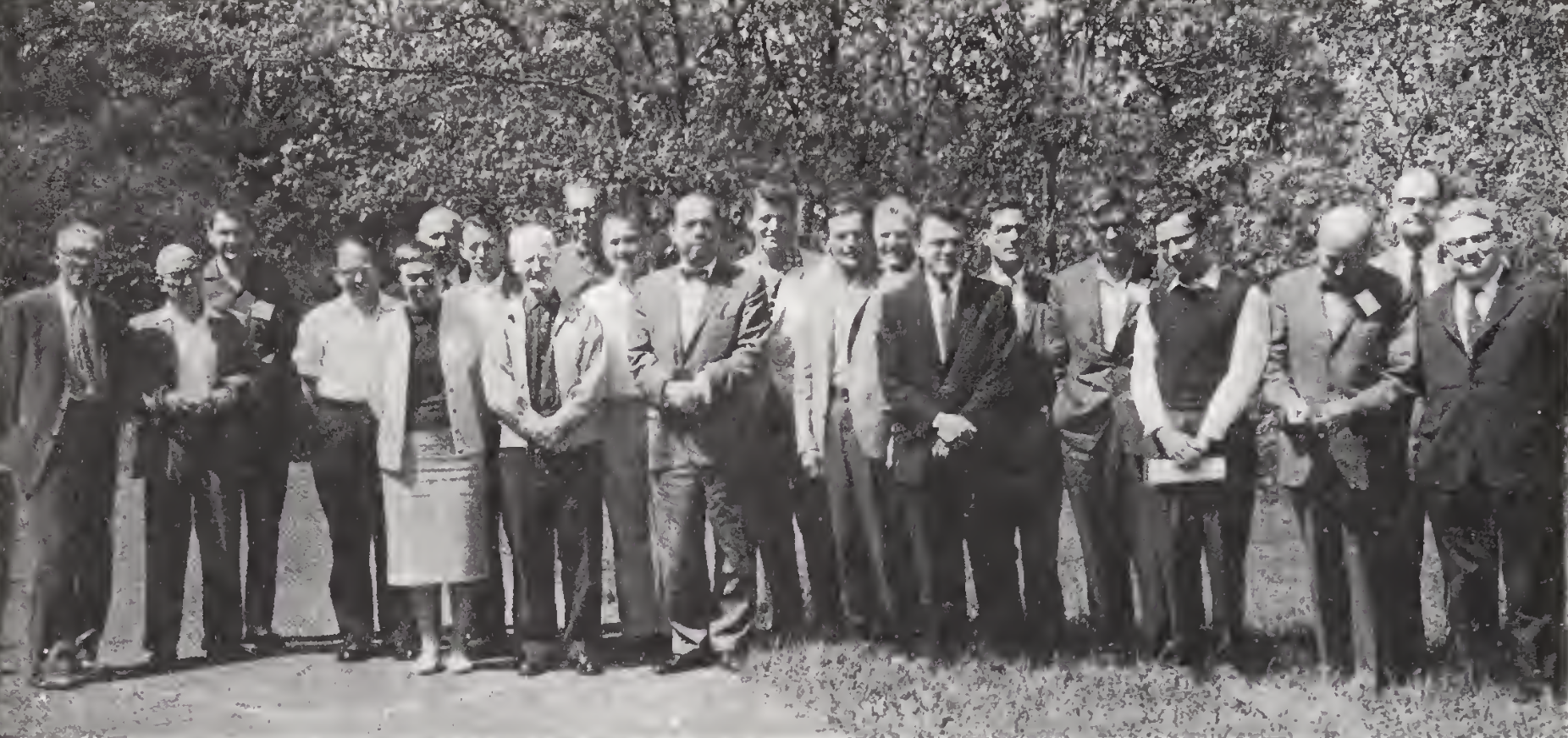
Participants in the 1961 Woodring Conference, including Cloud (second from the left). Also present were M. N. Bramlette, J. R. Vallentyne, H. D. Holland Dixie Lee Ray, S. W. Fox, H. L. James, W. H. Bradley, R. Stanier, D. Bonner, P. H. Abelson, C. B. Anfinsen, W. P. Woodring, M. K. Hubbert, T. C. Hoering, E. S. Barghoorn, N. W. Pirie, H. A. Lowenstam, M. Calvin, K. E. Lohman, and M. Florkin. (This list of names goes from left to right, and skips over Cloud)
The 1960s were a remarkable decade in the earth sciences. For one thing, the decade saw the rapid consolidation of plate tectonic theory, at once resolving a host of problems that had dogged the science since the earliest days of its conceptual development. This was a truly epoch-making event, probably the single most important development in the history of the earth sciences, and something that deserves to be mentioned in the same breath as, for example, Einstein’s relativity theory in terms of its world-changing impact and lasting importance. Still, it did not exhaust the achievement of geology during the 1960s, and while plate tectonics was reimagining the earth as a restless engine of lateral movement, an increasingly multidisciplinary community of scientists was constructing, for the first time, a systematic understanding of the first 85% of earth history.
The crucial year was 1965. That was the year Elso Barghorn and Stanley Tyler described the first well-preserved microbiotas of pre-Cambrian age that were generally agreed to be biological in origin. It was also the year Lloyd Berkner and Lauriston Marshall published their model of the primitive atmosphere, which involved the striking claim that rising oxygen had lit the fuse of the “Cambrian evolutionary explosion.”*
[* Two qualifications. Berkner and Marshall technically debuted this model in 1964, in an edited volume; but 1965 was the date of the paper that made the model known to a broad community of geoscientists. Also, the proposal that rising oxygen levels were behind the Cambrian explosion was not original to them. It had been hit upon, first, by an eccentric Canadian zoologist named John Nursall, in 1959, but again, it was the Berkner-Marshall paper of 1965 that gave it wide currency.]
Finally, 1965 saw the publication of perhaps the most influential paper Preston Cloud ever wrote, “Significance of the Gunflint (Precambrian) microflora.” It was, for one thing, a restudy of the Gunflint material, whose nearly simultaneous appearance with the original study owed to massive delays in the production of the original paper. (Stanley Tyler had died in 1963, leaving Elso Barghorn to finish the paper by himself.) Yet it was also an ideas paper— the result of years of thinking about the co-evolution of the earth and its physical environment during the chrysalis years of the 1950s and early-60s. Over the next decade, Cloud would assemble what he would term his “working model of the primitive earth,” a systematic attempt to map out the jointly biological and physical evolution of the earth over a period of nearly 4,000 million years. It was this model, more than anything else, that established Cloud’s legacy as a geobiologist. And so, it is with Cloud’s 1965 paper that I will begin Part 2 of this essay (for which a link will be placed here when it is available).
References
Barghorn, E. S. and Tyler, S. A. 1965. Microorganisms from the Gunflint Chert. Science 147:563–577.
Bjornerud, M. 2019. Reading seawater. Inference Review. https://inference-review.com/article/reading-seawater
Cloud, P. 1948. Some problems and patterns of evolution exemplified by fossil invertebrates. Evolution 2:322–350.
Cloud, P. 1961. Woodring conference on major biologic innovations and the geologic record. Proceedings of the National Academy of Sciences, U.S.A. 47:1705–1712.
Cloud, P. 1965. Significance of the Gunflint (Precambrian) microflora. Science 148:27–35.
Cloud, P. 1983. Early biogeologic history: emergence of a paradigm. In J. W. Schopf (Ed.), Earth’s earliest biosphere, 14–31. Princeton: Princeton University Press.
Cloud, P. and Glaessner, M. F. 1982. The Ediacarian System and Period: Metazoans inherit the earth. Science 217:783–792.
Knight, J. B. 1947. Paleontologist or geologist. Bulletin of the Geological Society of America 58:281–286.
Knoll, A. H. 1990. Introduction to the special issue: “Proterozoic evolution and environments.” The American Journal of Science 290:v–vii.
Knoll, A. H., Canfield, D. E., and Konhauser, K. O. (eds.) 2012. Fundamentals of geobiology. London: Wiley and Blackwell.
Olszewski, T. D. 2001. Geobiology– a golden opportunity and a call to action. PALAIOS 16:533–534.
Rodgers, J. 1992. Preston Cloud (September 26, 1912-January 16, 1991). Proceedings of the American Philosophical Society 136:280–287.
Roosth, S. 2025. “Geobiology.” Encyclopedia of the History of Science (September 2025). doi: 10.34758/zzgv-av25