Some Questions About Dinosaur Hips

Derek Turner writes . . .

A few weeks ago, the journal Nature published a paper arguing for a major revision of dinosaur phylogeny. You've probably seen it in the headlines. I’ll leave it to others to subject Matthew Baron, David Norman, and Paul Barrett’s phylogenetic analysis to careful scrutiny. (See this excellent piece by Darren Naish for some preliminary discussion.) But however things look when the dust settles, the paper has left me thinking a lot about dinosaur hips. And I have many questions, along with one modest philosophical argument to make.

The Old Picture

On the one hand, you have—or had?—your lizard-hipped (saurischian) dinosaurs. That group included all the big sauropods and their relatives, as well as the theropods. On the other hand, you have your bird-hipped (ornithischian) dinosaurs, including the iconic Triceratops, Stegosaurus, and Ankylosaurus, as well as all the hadrosaurs. The basic skeletal difference between the two is easy to discern.

If you look closely at a skeleton of, say, an alligator, you can see the two pelvic bones called the ischium and the pubis. Although alligators aren't really lizards, they too have the reptilian "lizard hip" design. The bigger bone on top of the hip socket is the illium. The pubis kind of points forward and down, while the ischium sticks out behind. (As you can tell, I am not exactly a connoisseur here, but luckily, the morphology is so easy to perceive that even us philosophers can do alright. But see also Dave Hone's helpful discussion here.)

The skeleton of an alligator. The red arrow is pointing at the pubis, which is sticking forward, while the purple arrow indicates the ischium. Image courtesy of wikimedia commons (though I added the arrows).

The skeleton of an alligator. The red arrow is pointing at the pubis, which is sticking forward, while the purple arrow indicates the ischium. Image courtesy of wikimedia commons (though I added the arrows).

Now if you glance at the pelvis of a theropod dinosaur, or one of the big sauropods, they look sort of like the alligator pelvis, at least, in the sense that the pubis and ischium bones are pointing in different directions.

T. rex has a lizard-like hip joint, with the pubis (red arrow) pointing down and a bit forward, and the ischium (purple arrow) jutting backward. Image courtesy of wikimedia commons (again, with the arrows added).

T. rex has a lizard-like hip joint, with the pubis (red arrow) pointing down and a bit forward, and the ischium (purple arrow) jutting backward. Image courtesy of wikimedia commons (again, with the arrows added).

And here's Apatosaurus. Notice how the pubis (red) also juts forward, away from the ischium (purple). Image courtesy of wikimedia commons.

And here's Apatosaurus. Notice how the pubis (red) also juts forward, away from the ischium (purple). Image courtesy of wikimedia commons.

However, if you look at the skeleton of a modern bird, the hips look totally different. The ischium and the pubis bones are kind of smooshed together, with the pubis pointing backwards.

The skeleton of an emu. See how the pubis (red) and ischium (purple) both point backwards. Image courtesy of wikimedia commons (arrows added).

The skeleton of an emu. See how the pubis (red) and ischium (purple) both point backwards. Image courtesy of wikimedia commons (arrows added).

The pelvis of a hadrosaur (one of the bird-hipped dinosaurs) looks more like the pelvis of a bird than like that of either a T. rex or an alligator. The pubis and the ischium bones are smooshed together and pointing aft.

A skeleton of Edmontosaurus. Note how the pubis (red) and the ischium (purple) are sort of smooshed together and pointing backwards.Image courtesy of wikimedia commons (arrows added). Also, in this dinosaur, there is a kind of bony flange sticking f…

A skeleton of Edmontosaurus. Note how the pubis (red) and the ischium (purple) are sort of smooshed together and pointing backwards.Image courtesy of wikimedia commons (arrows added). Also, in this dinosaur, there is a kind of bony flange sticking forward from the pelvic girdle, but that's a different structure, the anterior process, as Dave Hone explains here.

And for good measure, here's a Stegosaurus with the bird-hipped morphology. See how the pubis (red) and ischium (purple) are right up against each other. Image courtesy of wikimedia commons (arrows added).

And for good measure, here's a Stegosaurus with the bird-hipped morphology. See how the pubis (red) and ischium (purple) are right up against each other. Image courtesy of wikimedia commons (arrows added).

Until a few of weeks ago, the received view was that sometime back in the Triassic period, these two major branches of dinosaurs split off from one other and went their separate evolutionary ways.

The old dinosaur phylogeny that you probably learned as a kid.

The old dinosaur phylogeny that you probably learned as a kid.

But there was already something quite strange about this picture, even before Baron, Norman, and Barrett called it into serious question. We know that birds evolved from theropod dinosaurs—that is, from lizard-hipped dinosaurs. So somewhere in there—probably in the evolutionary trajectory of small maniraptorans, which gave rise to birds—there was a major change in pelvic morphology.

Actually, the change from lizard hips to bird hips might have happened several times (even on the old picture): It may have happened independently in birds and dromaeosaurs (think of Deinonychus and Velociraptor). Those dromaeosaurs, weirdly, have pubis bones that point somewhat downward and backward, even though the shape of the pubis reminds one of T. rex

This is Deinonychus--a weird case. It's a theropod, and so traditionally classified as saurischian, but the hip obviously looks kind of bird-like, with the pubis (red) pointing backwards and smoothed up against the ischium (purple). Compare it to th…

This is Deinonychus--a weird case. It's a theropod, and so traditionally classified as saurischian, but the hip obviously looks kind of bird-like, with the pubis (red) pointing backwards and smoothed up against the ischium (purple). Compare it to the emu above. Image courtesy of wikimedia commons (arrows added).

And then there are the enigmatic therizinosaurs—another theropod group that also acquired a more bird-like hip construction. Why did these changes occur?
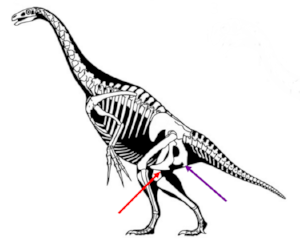
Another weird case. This is a reconstruction of a therizinosaur.. Therizinosaurs were theropods, hence saurischians (on the old picture), and yet they too seem to have had the pubis (red) smooshed up against the ischium (purple). Image courtesy of w…

Another weird case. This is a reconstruction of a therizinosaur.. Therizinosaurs were theropods, hence saurischians (on the old picture), and yet they too seem to have had the pubis (red) smooshed up against the ischium (purple). Image courtesy of wikimedia commons (arrows added).

Another question: What sort of hips did dinosaurs start out with? Did they start out with lizard-like hips, or bird-like hips? Suppose, as seems likely, that they started out with lizard-like hips. That would mean that the transition from lizard-like hips to bird-like hips happened on one more occasion, in the ornithischian dinosaurs. (By my count, that’s as many as four distinct transitions from lizard hips to bird hips.) Or suppose the basal condition for dinosaurs was bird-like hips. In that case, you’d have an evolutionary zig-zag, with lizard-hipped dinosaurs evolving from bird-hipped ancestors, and bird-hipped birds evolving from lizard-hipped dinosaurs. Either way, there is quite a bit of explaining to do.

The New Picture

Baron, Norman, and Barrett argue that the old saurischian/ornithiscian classification gets things wrong, because it turns out that theropods are more closely related to ornithischian dinosaurs than to sauropods. They concluded this on the basis of a phylogenetic analysis of more than 400 characters, in dozens of dinosaur species from the Triassic and early Jurassic. Importantly, they looked at many characters that no one had previously fed into a phylogenetic analysis--and many details having nothing to do with the hip joint. (I am obsessing about the hip joints here, but they do not.)

The newly proposed phylogeny. Might have to rewrite all those dinosaur books.

The newly proposed phylogeny. Might have to rewrite all those dinosaur books.

According to this new picture, theropods and ornithischian dinosaurs together form a clade, now called the Ornithoscelida ("bird-limbed"). They keep the old name "saurischian" for the sauropods (or more precisely, the sauropodomorphs) together with another group, the herrerasaurs. [Note: this is a little confusing because, as we just saw, most theropods had lizard hips too. They now no longer count as saurischian, or "lizard-hipped"! But we shouldn't get too hung up on names. We could call the saurischians "Dino team A" and the ornithoscelidans "Dino team B" if we wanted to.]

Anyhow, the new picture suggests that the lizard-style hip construction is basal or ancestral for dinosaurs. In the early to mid-Triassic, when dinosaurs first evolved, and when the saurischians (sauropodomorphs + herrerasaurs) branched off from the ornithoscelidans (everyone else), everyone concerned had lizard hips. Then later on—possibly in the mid to late Triassic—the ornithoscelidans branched in turn into two groups. The theropods kept the ancestral lizard hips, though some of them would lose that morphology later on, when they evolved into birds, dromeosaurs, and therizinosaurs. But the ornithischians (for whom, sadly, the Triassic fossil record is pretty sparse) evolved the bird-hipped morphology pretty early on.

Some Questions About Dinosaur Hips

One striking thing about the proposed phylogenetic revision is that if we focus narrowly on the evolutionary history of one particular trait—the pelvic morphology—both the old and the new pictures provoke some of the same questions. Why, for example, did some lineages evolve the bird-hipped construction? And why did some groups, like the sauropods, retain the lizard-like construction for the long haul? Given that the hip structure changed in dromaeosaurs, why did it remain so stable in tyrannosaurs? And why do you see bird-hipped morphologies evolving from the lizard-hipped design, but (probably) not the other way around?

Some of the explanations that come readily to mind face obvious problems. For example, you might think that pelvic morphology has everything to do with locomotion. But then it’s hard to see why bipedal theropods and quadrupedal sauropods should have the same lizard-like hip morphology. Dinosaurs with a more bird-like hip construction also include both obligate quadrupeds (think of ornithischians like Stegosaurus) but also likely bipeds (maybe the dromaeosaurs, and—of course!—birds). So there just doesn’t seem to be any clear connection between this particular aspect of hip morphology and locomotion.

Another suggestion is that the bird-hipped construction, with the pubis pointing backwards, leaves more room for a larger gut. And a larger gut is a great idea for an animal that needs to digest big quantities of nutrient-poor plant material. This could well explain what was going on in the ornithischians, most of which were herbivores, as well as the therizinosaurs, which are now thought to have been an exceptional case of herbivorous theropods. But even this explanation runs into trouble: why did the ginormous sauropods retain their lizard-like hip construction? And why do you see more bird-like hips in the dromeosaurs, who were obviously carnivores? 

Both the old phylogeny and the new revised one leave us with big (and as far as I know, largely unanswered) questions about why dinosaur hip morphology underwent evolutionary changes. How might scientists explore these questions further? One approach might be to study skeletal development in modern birds, so as to learn more about the developmental processes that generate the morphologies, but I'm not sure how promising that would be. If you have thoughts or speculations about how to address these questions, please feel free to share in the comments.

A Thought Experiment

There might be a further problem even with the way I've framed some of the questions above. I've been following tradition in characterizing dinosaur hip morphology as bird-like vs. lizard-like. I've also been thinking of evolutionary change as a change from one hip design to the other. But even a brief survey of the images above reveals that this is oversimplified.  Dinosaur hips, including bird hips, vary in all sorts of ways. There are lots of evolutionary changes in hip structure that might not involve a shift from the lizard-like to the bird-like architecture. With that in mind, consider a thought experiment:

The Sheltered Paleontologist. Imagine a paleontologist who has somehow been sheltered from the world, and who has never had the opportunity to observe a bird or a lizard (or an alligator). But this scientist has made an extensive study, over the course of a whole career, of non-avian dinosaur hip joints. The sheltered paleontologist has studied every non-avian dinosaur hip so far extracted from the fossil record. Not only that, but the sheltered paleontologist has carefully mapped out the morphospace of non-avian dinosaur hip construction, with the aim of documenting trends and patterns in non-avian dinosaur hip evolution.

The sheltered paleontologist would not--could not--describe dinosaur hips as either bird-like or lizard-like. And so, when framing questions about the evolution of dinosaur hip morphology, the sheltered paleontologist would not fame them as I did above, as questions about the transition from a lizard-like to a bird-like design. The questions would have to be framed in some other way, relying on some other way of describing the skeletal features.

Since we can't observe dinosaurs directly, it's extraordinarily difficult for us to avoid using living organisms--birds and lizards, for example--as models for them. The thought experiment shows how this can affect even our descriptions of dinosaur morphology, and our decisions about how to individuate morphological characters. In writing this post, I actually set you up to "see" dinosaur hips a certain way, by first showing pictures of alligator and bird hips. Once you start seeing them that way, it's hard to get that distinction out of your head. But there is no reason, in principle, why anyone has to describe dinosaur hip morphology as bird-like or lizard-like.

So here's one last question about dinosaur hips: If the proposed revision to dinosaur phylogeny holds up under scrutiny, should the distinction between lizard-like hips and bird-like hips remain entrenched as a way of describing dinosaur morphology and framing evolutionary questions? If not, what should replace it?

Thanks

This post was inspired by a recent meeting of the paleontology reading group at the University of Calgary, where we discussed the new paper by Baron, Norman, and Barrett. Some of my questions about dinosaur hips are inspired by things that were said in that conversation. I'm grateful, and I hope I haven't botched anything too badly. 

Reference

Baron MG, Norman DB, Barrett PM (2017), "A new hypothesis of dinosaur relationships and early dinosaur evolution," Nature 543: 501-506.


Much Ado About Niches

Biologists sometimes talk about niches as if they are independent of the organisms that fill them. Adrian argues that we shouldn't take such talk so seriously, by examining the role niches play in investigations of Aotearoa's (New Zealand) extinct giant bird, the moa.

Read More

Parsimony Revisited

Leonard Finkleman writes…

Last year I wrote an essay about cladistics and parsimony. It made some rounds and then the deadline for the following month’s essay came up and I turned my thoughts to other things. I suppose this hit-and-run mentality is what we call “blogging.”

This year I took a midterm exam for this first time in more than a decade. While I did well (as one would hope that a full-time professor might), confronting the errors I made on the exam has forced me to revisit my thoughts on parsimony. Today I have to admit: I committed a small error on the exam that’s since revealed a greater error in my approach to cladistics. So, you know, mea culpa.

(That’s right! Philosophers do admit mistakes. The admissions are just expressed in languages they don’t speak.)

Here’s what you’re now getting into: first I’m going to talk about significant figures in scientific measurement and draw out their broader meaning in scientific research; then I’m going to turn back to cladistic parsimony and argue, against the ghost of my 2016 self, for an a priori reason to favor that approach in paleontology.

This is admittedly a dry post, so here's a feathered tyrannosaur (Gorgosaurus libratus) to reward your patience. Art by John Conway.

This is admittedly a dry post, so here's a feathered tyrannosaur (Gorgosaurus libratus) to reward your patience. Art by John Conway.

"Sig figs"

Some day will be my last and on that day I’ll be able to tell you the convention for significant figures in science writing. I’ll be able to do that because I forgot it on my midterm and took some knocks for the forgetting. In that sense my error was a productive one: I won’t make it again. I can’t imagine wanting to talk about this on my last day, but at least the option is there.

What is the convention? Scientists aim for precision as well as accuracy in their measurements, but different fields have different standards of precision. A geologist studying rock strata laid down over thousands of years can hardly be expected to resolve measurements to the same timescale as a particle physicist studying nearly-instantaneous subatomic reactions. Hoping to standardize reporting of numbers in scientific publications, Eisenhart (1968) recommended the following: state a measurement’s potential error to two significant digits and state the measurement itself to the resulting number of digits given for the potential error.

In enrolling for paleontology classes, my goal was not only to learn what paleontologists do, but why they do it. So I did some digging into why this should be the convention.

Alas! Like a bad field season, my digging didn’t turn much up. Eisenhart didn’t justify his recommendation. His paper is a master class in the “it’s right because it is said to be right (by me, who would never use the word ‘I’ in print)” school of science writing.

For my own part, however, I see two goals accomplished through maintenance of Eisenhart’s convention. First, it relativizes scientific measures to the appropriate degree of uncertainty in the discipline. If a discipline’s measurements are uncertain within a calculated range, then that range of uncertainty then determines the discipline’s most precise measurements (i.e., the ones that ought to be reported). The second goal accomplished is to ensure that the expression of a measurement’s uncertainty is never trivial. All scientific results are uncertain to some degree and reporting of those results should reflect that.

Bear in mind that “error” and “uncertainty” are terms of art in scientific practice. They aren’t assessments of truth function or attitudes towards other beliefs. They are, in fact, measurements. When Renne, et al. (2013) measured the age of the Cretaceous-Paleogene event at 66.043 ± 0.043 Ma, the uncertainty—± 0.043 million years—measures not anything about the given value of 66.043, but instead about the range of values that the natural world would yield. Very roughly, scientific error and uncertainty measure just how much our perceptions (i.e., statistical samples) represent the fullness of reality (i.e., populations).

This is (perhaps) another reason why Eisenhart might have thought that significant figures should be determined by uncertainty measures rather than by reported values. A realist assumes that reality determines perception and not the other way around, after all.

You're really sticking it out! As a token of my thanks, here are some woolly Pachyrhinosaurus. Art by Mark Witton.

You're really sticking it out! As a token of my thanks, here are some woolly Pachyrhinosaurus. Art by Mark Witton.

What I got wrong in my (relative) youth

In my parsimony post, I wrote:

…we would recognize paleontology as a distinct and matured discipline (rather than as a handmaiden to other life sciences) if we could find some kinds of information uniquely valued in paleontological research. Qualitative similarity and temporal placement seem to be two such kinds of information. Inability to account for these kinds of information also happens to be the greatest weakness with cladistic parsimony.

In other words: phylogenetic reconstruction of extinct taxa depends on features that are difficult to quantify (although some cladists have given it the old college try), and so using cladistic parsimony to reconstruct evolutionary relations puts paleontologists at a unique disadvantage. Put yourselves in a position to succeed, people!

I maintain that there are philosophical problems in defining the populations from which fossil samples are drawn. But this is not to say that phylogenetic reconstruction of extinct taxa is purely a matter of perception. Rather, it's a matter of which element of reality we're trying to describe. It might be the relations between features of the fossils themselves (as I've hinted elsewhere) or it might be the evolutionary histories of the once-living animals that left those fossils behind. I'm leaning towards the former view because extinct populations are unobservable in principle rather than in practice, but in either case our phylogenetic reconstructions attempt to capture something real.

In scientific practice measurement of reality (rather than of perception) is expressed in terms of error and uncertainty. If paleontology is to be recognized as a mature and distinctive science, then, its research outcomes must include uncertainty measures. Those uncertainty measures relativize the degree of precision possible in paleontological measurements. All well and good so far.

Cladistic parsimony is one among several analytical methods in phylogenetic reconstruction. The purpose of these methods is to quantify and to measure relatedness between taxa. But among those paleontologists who don't share my esoteric views regarding the metaphysics of fossils, the reality to be captured in phylogenetic reconstruction is not relatedness per se. Relatedness is only a proxy for evolutionary history.

What parsimony measures do that other measures don't is attempt to quantify macroevolution itself. It does this by counting the number of evolutionary changes required to generate an hypothesized evolutionary history. In so doing, the uncertainty of the analysis—its relation to (unobserved) real evolutionary history—can be quantified. Without that measure, hypotheses about evolutionary history would lack an appropriate quantified context.

My original argument was that paleontological hypotheses about evolutionary history would always be imprecise relative to hypotheses generated by other life sciences. That's still true: molecular biologists, for example, can work with much higher-resolution data about changes in the genome. But this is only a problem if paleontologists are held to the same standards of precision as (say) molecular biologists. I now recognize this assumption as false. Maintaining the significant figure convention ensures that measurements in a scientific discipline are held to a standard of precision appropriate to that discipline. The defense against unfair critiques of imprecision (which was my original concern) is built into reporting practices.

Halcyon days of yore!

Halcyon days of yore!

I still think that there are problems with the integration of paleontological and neontological data. Nothing that I've studied so far has allayed those suspicions, and if anything I'm now more convinced of that. But the harsh lesson about significant figures (delivered with the deduction of a full point of credit!) has at least tempered my views in this one respect: maybe paleontology can be more amenable to parsimony analysis than I originally thought.

Works Cited

  1. Eisenhart, C. (1968). Expression of the Uncertainties of Final Results: Clear statements of the uncertainties of reported values are needed for their critical evaluation. Science160(3833), 1201-1204.

  2. Renne, P. R., Deino, A. L., Hilgen, F. J., Kuiper, K. F., Mark, D. F., Mitchell, W. S. 3rd, Morgan, L.E., & Smit, J. (2013). Time scales of critical events around the Cretaceous-Paleogene boundary. Science339(6120), 684-687.

The Wilderness Before Time

Derek Turner writes …

Once I asked a class on environmental ethics how they would define “wilderness.” One student half-jokingly said that “wilderness is any place you can go, where other animals might eat you.” Anyone familiar with Werner Herzog’s film, Grizzly Man, will know that there is something right about this.

Timothy Treadwell, in Alaska's Katmai National Park. This does not end well.

Timothy Treadwell, in Alaska's Katmai National Park. This does not end well.

My student’s comment contains an insight: wilderness is where we go to be reminded that nature doesn’t care about us, and that nature always has the last word.

What if the spiritual pull that draws us to dinosaurs is not that different from what draws us to Denali? Or to Alaska's Katmai National Park, which provided the setting for Grizzly Man?

Like Timothy Treadwell, the subject of Herzog’s film, some of the characters in Jurassic Park also get up close and personal with animals that can, and sometimes do eat them.

"Wilderness is any place you can go, where other animals might eat you." 

"Wilderness is any place you can go, where other animals might eat you." 

Is there a connection between wilderness and paleontology?

Consider the following argument:                                                                             

P1. Wild landscapes—places where humans have no permanent presence, and where human activities have relatively little impact—are especially valuable.

P2. Pre-human landscapes were wild.

C.  Therefore, pre-human landscapes were especially valuable.

Let’s call this the WBT (“wilderness before time”) argument.

(I discuss some other possible connections between paleontology and environmental thinking in earlier posts, here and here.)

Is the WBT argument a good one? It is valid, meaning that the conclusion follows logically from the premises. But are the premises true?

The Prehistoric Wild

P2 looks to be in pretty good shape. The pre-human world was wild if anything is. Some have argued that no place on Earth today is truly wild, because human activities—especially the burning of fossil fuels—have altered every square inch of the planet.[1] However, the pre-human wild was the real deal, completely unaffected by anything that humans would ever do in the future. Because we cannot intervene in the past, we can do nothing to “tame” or “civilize” the pre-human wilderness.

Troubles with The Wilderness Concept

P1 is more questionable. Many environmental thinkers in North America, at least since John Muir, have held that wild places have special (possibly intrinsic) value. There have been many efforts to get clear about the value(s) of wilderness, and the literature on this issue in environmental ethics is vast.[2] Speaking autobiographically, though, reading William Cronon’s classic essay, “The Trouble With Wilderness,” has made it very tough for me to get behind P1.[3] 

Perhaps the most serious problem (though by no means the only one) concerns the often violent history of mistreatment and displacement of Native American and First Nations communities. In North America, many of our cherished “wild” places are landscapes that people had lived in and loved and modified and been modified by for a very long time before disease-bearing Euro-American settlers showed up. In some cases, newcomers forced Native people out and subsequently declared those places “wild,” as if they had always been empty, or as if the people living there were less than human. The idea that such areas are untrammeled by humans is a mythical smokescreen that hides a history of injustice. It’s hard to see how to treat wilderness as an anchoring environmental value without confronting this history.

Gratuitous wilderness shot, from a backpacking trip in the Sierra Nevadas, at Thousand Island Lake in the Ansel Adams Wilderness.. Does the human presence mar the scene? 

Gratuitous wilderness shot, from a backpacking trip in the Sierra Nevadas, at Thousand Island Lake in the Ansel Adams Wilderness.. Does the human presence mar the scene? 

Another problem with P1 is its negative anthropocentrism. The idea that something has value in virtue of the fact that humans have not interacted with it implies that human interaction with something diminishes the value of that thing. Hence the injunction to "leave no trace" in the wilderness. But that’s just as arbitrary and unmotivated as positive anthropocentrism, the view that membership in a particular biological species confers special moral status. One could just as well define “wilderness” as any place that’s unoccupied and untrammeled by some other nonhuman species—any place untrammeled by squirrels, for example.                                                                                                    

There is much, much more to be said here, but these are two main reasons why I hesitate to defend P1. When it comes to fundamental environmental values, it might be more helpful to talk about biological diversity, or ecological health, or sense of place, or the value of individual living things and biological relationships.

Nevertheless, wilderness can exert a profound pull, even upon those of us who are more than a little skeptical. We go—at least, those who are lucky enough to be able to afford the cost of transportation and the expensive backpacking gear—in order to be humbled and perhaps tested. We go to be reminded that nature, like the gods of the ancient Epicureans, is utterly indifferent to human life and well-being.

So the WBT argument is valid, and P2 is true, but P1 is problematic. I’m therefore not sure we should buy it. But let’s think about what the argument might mean for paleontology.

Paleontology and the wild, Pre-Human Past     

It’s no coincidence that paleontology started to capture the American imagination in the late nineteenth and early twentieth centuries, at precisely the moment in American cultural history when people like John Muir and Theodore Roosevelt begin to lament the “closing” and the “taming” of the North American wilderness. The wilderness preservation movement was born of nostalgia: The distinctive American character was forged in the process of developing and cultivating the wild frontier—or so went the story told by Frederick Jackson Turner and others—and we need to preserve remaining wild places so that people can continue to have those formative experiences. At the same time that the federal government was establishing national parks—Yellowstone in 1872, Yosemite in 1890, followed by many others—wealthy philanthropists were establishing museums in New Haven (1866), New York (1869), Chicago (1893), and Pittsburgh (1896), institutions whose mission was to give people a window on a prehistoric wilderness that really was untrammeled, and where lots of animals would have been happy to eat you or crush you underfoot.

The WBT argument suggests that paleontology might have, in addition to various epistemic goals, the non-epistemic one of putting us in touch with pre-human wilderness.

The scientific effort to reconstruct the deep past is, perhaps in part, a kind of cognitive backpacking trip—a way of visiting a landscape, one displaced from us in time rather than in space, and one whose value depends on the fact that humans do not belong there. The joys of paleontological reconstruction may derive in part from the promise of access to wilderness. This points to another way in which the scientific study of the deep past is suffused with the values of the broader culture (See Joyce’s great discussion that issue here.) Perhaps we feel impelled to reconstruct prehistoric landscapes because they have value qua wilderness.

The familiar epistemic goals of historical natural science blend with nostalgia for wild places that are increasingly hard to find.

In an earlier post, I suggested that dinosaurs might be overrated, in the sense that their high cultural profile is out of proportion to their scientific importance. Why, for example, is it more important to figure out the colors of the dinosaurs than to figure out why the ammonoids had such high speciation and extinction rates?[4] The WBT argument, together with my student’s observation, goes some way toward accounting for this. Perhaps we want to do our cognitive backpacking across prehistoric landscapes where some of the animals could eat us. 


[1] One person who made this point relatively early was Bill McKibben, The End of Nature, Random House, 1989.

[2] See especially the papers collected in The Great New Wilderness Debate, edited by J. Baird Callicott and Michael Nelson, University of Georgia Press, 1998, as well as The Wilderness Debate Rages On, edited by J. Baird Callicott and Michael Nelson, University of Georgia Press, 2008.

[3] William Cronon (1995) “The Trouble with Wilderness, Or Getting Back to the Wrong Nature,” in Uncommon Ground: Rethinking the Human Place in Nature. New York, W.W. Norton, pp. 69-90.

[4] M.M. Yacobucci (2016), “Towards a model for speciation in ammonoids,” in Species and Speciation in the Fossil Record, edited by W.D. Allmon and M.M. Yacobucci. Chicago: University of Chicago Press, pp. 238-277.