* Almost three years ago, I wrote the first part of an anticipated two-part essay on the Darwinized Gaia hypothesis. Near the end, I promised to conclude the essay “later”— and, though “later” has turned out to be later than I intended, I’m going to do it now. What’s changed between now and then is that a substantial amount of work has appeared on the Darwinized Gaia hypothesis, authored by a diverse group of scientists and philosophers. This work has made most of all the points I intended to make, often much better than I would have made them. Still, I want to finish my essay, and to make a few points in my own words. So that’s what I’ll do, using some recent papers as a springboard. (Two papers in particular: those by Boyle, and Hermida and Okasha, although I’ve benefited from Doolittle’s precis of his recent book, and from Arthur and Wilkinson’s essay in PTPBio.)
Happily, this is the fiftieth installment of my essay series “Problematica.” I had planned for the fiftieth to be the second part of my essay on Preston Cloud, but that isn’t done and anyway, this seems more fitting. Fifty is a big number— I still remember writing the first one, and wondering if I’d have enough ideas to keep the blog going for six months. Anyway, I haven’t run out of ideas yet. Probably my run at Extinct is nearing an end; I might have another six months in me, maybe a year. But it’s heartening to know that, when I’m finished, it won’t be because I’ve run out of ideas. Fifty essays and counting.
“Problematica” is written by Max Dresow…
“Why in the hell would you want to Darwinize the Gaia hypothesis?” a scientist growled at me in 2024.
“Maybe I wouldn’t,” I replied. But others are interested in whether the existence of planetary self-regulation can arise by natural selection, or, failing that, whether “Gaia” can even exist within a Darwinian world.
“But… Gaia?” he stammered, awash in incredulity.
“Nothing funny,” I replied. “Just the idea that the earth system behaves in a way that maintains the habitability of the planet.” I might have added that this “behavior” implicates the biosphere, specifically, and that— according to some— the regulatory apparatus needs to be understood as an evolved homeostatic mechanism, directly analogous to the homeostatic mechanisms in living organisms.
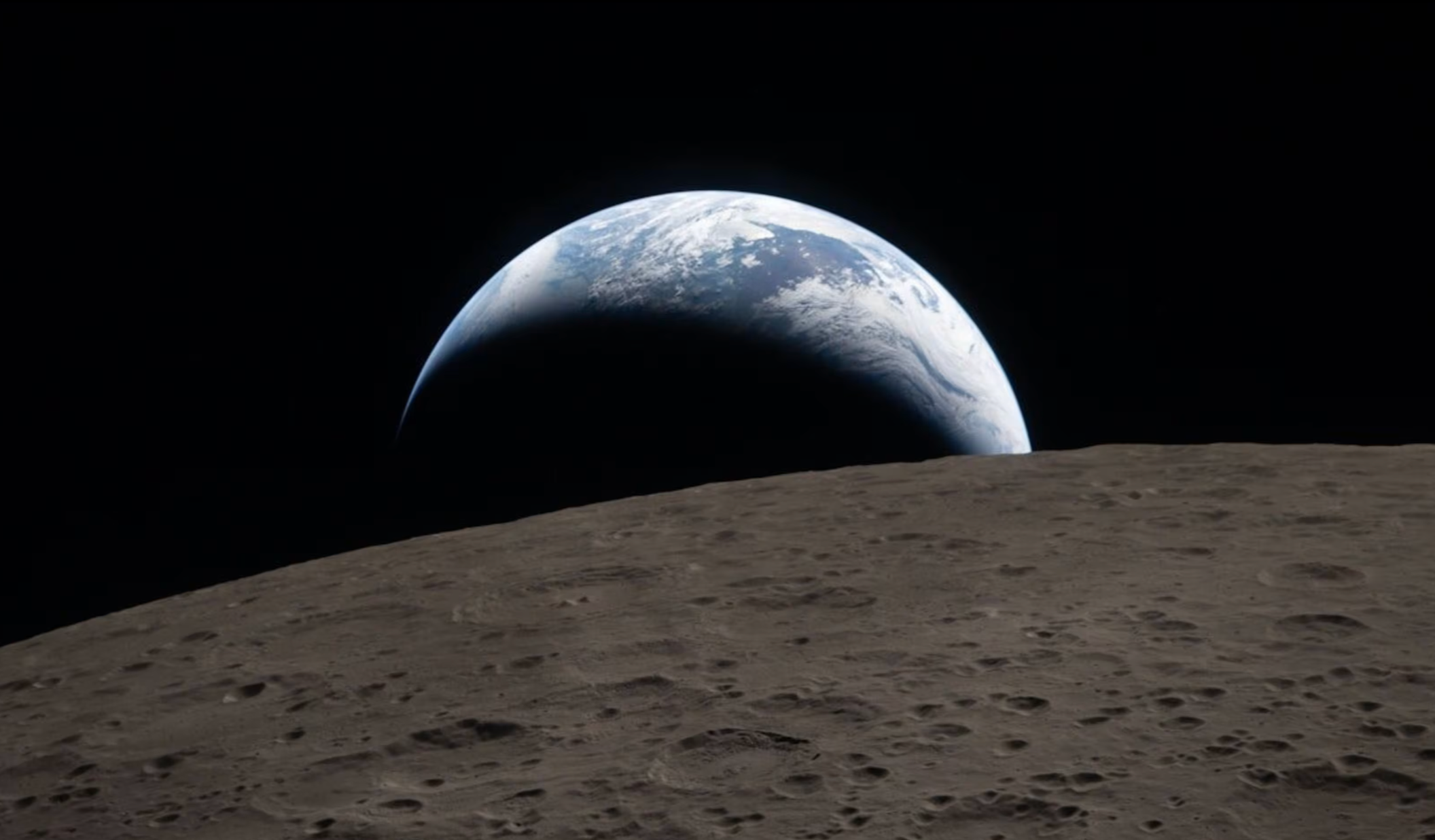
“Gaia” rising (photograph from Artemis II)
I should have said this because it’s the latter claim— the notion that Gaian self-regulation is an evolved homeostatic mechanism— that generates the Darwinian puzzle. That is: how, in a world governed by Darwinian processes, can something like Gaia come to be? To many biologists, it is simply unthinkable that natural selection can produce self-regulation at a planetary scale, since this would involve thinking that organisms “which behave in such a way as to contribute to the maintenance of Gaia have a greater probability of leaving offspring than those which do not” (Doolittle 1981, 60). At any rate, the question Gaia must confront is whether “there [is] any conceivable way in which, on average and over the entirety of Earth’s history, habitability promoting genotypes tend to have a greater time-integrated fitness than genotypes that destroy habitability or have a neutral effect?” (Boyle 2025, 3).
Faced with this puzzle— Richard Boyle argues in a recent paper— scientists have three options. The first is to deny that Gaian self-regulation exists, which obviates the need for a Darwinian intervention. According to Toby Tyrrell, for example, the supposedly Gaian properties of the earth-life system are best explained by interactive coevolution between life and its environment (Tyrrell 2013). Tyrrell notes that atmospheric disequilibrium— a pillar of the Gaia hypothesis— does not require active self-regulation by the biosphere: only the constant perturbation of the atmosphere by living things. He also argues that the macronutrient composition of marine surface waters reflects “feedbacks acting on the boundary conditions for growth of different forms of life, and is not analogous to intra-organism homeostasis” (Boyle 2025, 3). So “Gaia” is a poetic hallucination; the long-term maintenance of habitable conditions on earth requires no special account; and the Darwinizing project is unmotivated.
The second option is to accept the reality of Gaian self-regulation, but to insist that “Gaia is somehow caused by life but not by selection” (Boyle 2025, 4). Perhaps Gaia is an expression of “a general stability producing tendency exhibited by complex systems.” Or perhaps, as Tyler Volk has argued, Gaian self-regulation arose “for free” via excreted waste products (Volk 1998). (In Boyle’s language, “Perhaps the byproducts of life increase the variety of chemical reactions that are present within the Earth system, and homeostasis/habitability emerges as a result.”) Yes, perhaps— and the possibility deserves further consideration. But given what we presently know, there’s no obvious reason to expect “the average effect of life’s physiological byproducts [to] have any systematic impact on habitability, any more than the products of abiotic processes” (Boyle 2025, 5). And anyway, some would dispute that a regulatory apparatus woven from excreted byproducts is truly “Gaian.” If you insist that the Gaian apparatus is an evolved homeostatic mechanism, then a self-organized network of metabolic waste isn’t Gaia— it’s a trash heap.
The third option, you will have guessed, is to Darwinize Gaia. That is: you can treat Gaia as a real thing, and show— somehow— that it is the expected result of natural selection grinding away at a certain level of organization. Maybe it is individual organisms in populations. (But then how likely is this kind of selection to produce Gaian behavior lasting for billions of years?) Or maybe it is something more exotic, like the selection of competing clades, or biogeochemical cycles. Anyway, the trick is to show that Gaian behavior is the expected result of Darwinian processes working on earth-like materials, and so to render explicable what was previously mysterious and unsatisfactory.
Ford Doolittle
As I noted in Part 1 of this essay, the leader of the Darwinizers is W. Ford Doolittle: a prominent early critic of Gaia. Doolittle now thinks that Gaia can and should be Darwinized, and insists that a “proper Darwinization requires that we interpret global homeostasis as resulting from natural selection operating directly to favor global stability” (Doolittle 2017, 13). But how is this possible? There is no population of Gaia’s that vary in heritable characteristics, and no Gaian reproduction in the ordinary sense. How then can global homeostasis have evolved by natural selection, when there is just one Gaia, and this a vestal virgin?
Doolittle makes several suggestions. The first involves the idea that natural selection can operate through persistence alone, whenever non-reproducing (and potentially immortal) entities acquire persistence-enhancing “mutations.” Inasmuch as these mutations are responsible for enhanced persistence, selection can be said to be operating in the absence of reproduction. (Of course, the term “selection” has here lost all connection with Darwin’s original metaphor. Especially in the Gaian case, where there is just one potentially immortal entity, nature cannot be said to be selecting— choosing— anything, unless it chooses the same thing again and again.)
Another suggestion, not entirely independent, is that selection may be operating among competing biogeochemical cycles. Doolittle discusses this in the context of his “its-the-song-not-the-singers” (ITSNTS) theory, which imagines non-replicating variants of these cycles, together with the genotypes (microbial metabolisms) that sustain them. In Boyle’s synopsis:
Continuous re-association between such genotypes and the nutrients/growth substrates on which they depend constitutes ‘re-production’ of the cycle-biota interaction, a process-level regeneration of the collective ‘song’, without replication in the conventional evolutionary sense. The taxa (singers) lead to the collective existence of the cycle (song), and the cycle’s existence perpetuates the niches that these taxa require. Crucially, ITSNTS proposes that this situation is more than just [the fortuitous consequence of selection on genotypes] because persistence selection makes a difference to the genetic composition of the biosphere: novel alleles/genotypes arise and increase from rarity via natural selection, by virtue of an interaction with a geochemical cycle, such that absent past persistence selection for this interaction, these biological novelties would not arise. (Boyle 2025, 6)
They would not arise because, as Boyle puts it, the relevant taxa “would be absent or fundamentally different.” Anyway, the key point for the Darwinization project is that natural selection can occur between populations of genotypes comprising different cycle-variants (which themselves constitute a population of cycles). Moreover, since there is a “cycle-interaction component of fitness” for the relevant genotypes, the selection of cycles is not simply epiphenomenal— there is a definite sense in which selection can be said to be operating on the cycles themselves.*
[* Adding his own wrinkle to the model, Boyle observes that “the process-level persistence selection invoked by ITSNTS can [be understood] as a form of group viability selection (groups of altruists survive better than groups of cheaters) for elemental recycling” (Boyle 2025, 7). If this recycling can be further supposed to have habitability-enhancing consequences, such selection may be implicated in the emergence of Gaian self-regulation (see Boyle et al. 2025).]
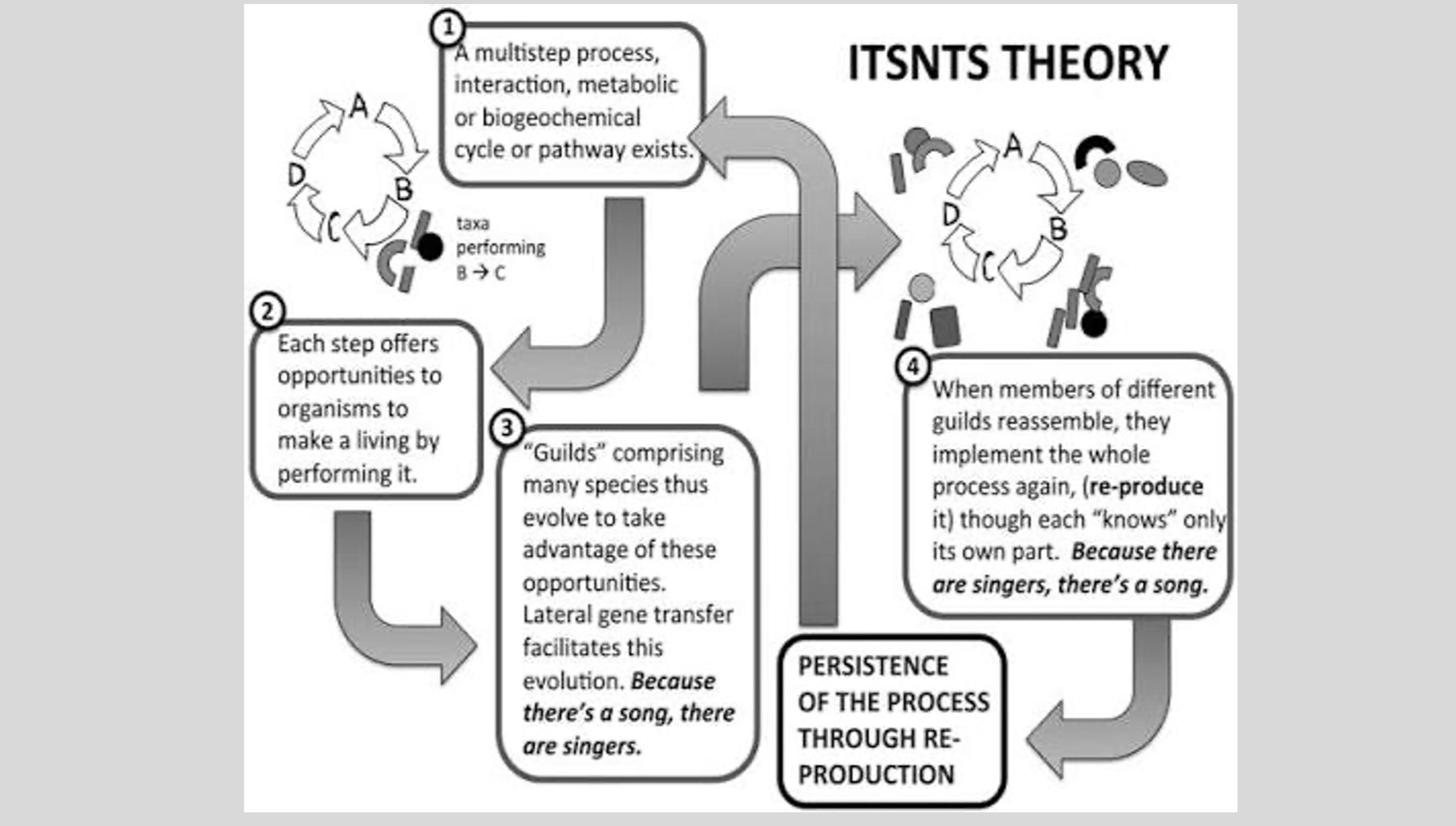
ITSNTS theory, in graphic synopsis
Coming at the matter from a different angle, Tim Lenton and colleagues have recently described a process they term “sequential selection” (Lenton et al. 2018). Here, the earth-life system is imagined to have gone through a series of trials, during which the activity of the biota either stabilizes or destabilizes the global environment. If the effect is destabilizing, a critical point will eventually be reached where system will collapse, after which a new system will emerge, perhaps very different from the one that came before. But the system needn’t collapse. In a happier contingency, an evolutionary innovation might nudge the system into a new and more stable condition. Thus, by a ratchet-like process, the earth-life system could evolve greater and greater levels of stability— the Gaian pathway.*
[* Rudy Arthur and Arwen Nicholson— two architects of the model— describe it as “selection by survival operating by repeated, sequential, trials, rather than simultaneously across a large population,” drawing a connection with Doolittle’s work (Arthur and Nicholson 2022).]
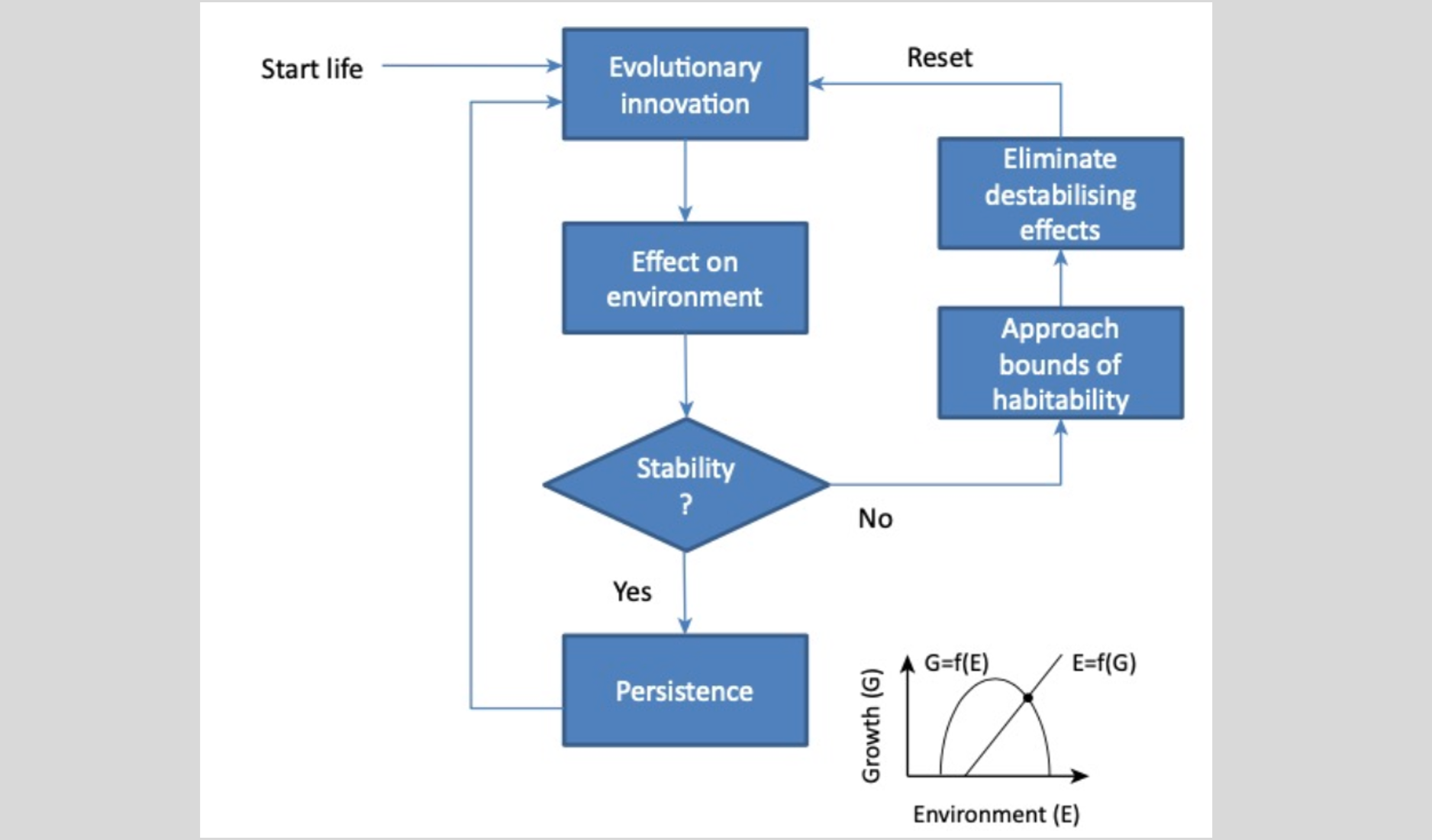
The model of sequential selection
There is much in these models that remains unsatisfactory. It is unclear, for instance, how we might individuate biogeochemical cycles in order “to tell which instances should be considered variants of the same cycle (and therefore, potentially undergoing persistence selection), and which ones should be considered cooperative” (Hermida and Okasha 2025, 5). Also unclear is how we might de-idealize the model of sequential selection. Lenton and colleagues say, for instance, that “environment-improving innovations [may] produce positive feedback on growth, which if strong enough can pass through optimum conditions and cause a switch to environment-degrading effects creating negative feedback on growth and convergence on a stable attractor” (Lenton et al. 2018). But what does this mean in terms of actual earth system processes? We should like to know, or else the model will remain difficult to evaluate, whatever its apparent plausibility.
These are difficult problems— far too difficult to address here. Instead, I want to consider two separate issues, each of which has received some attention recently. These are, first, the motivation for Darwinizing Gaia— how important is the project, anyway? And second, the Darwinian credentials of these models— just how Darwinian are the existing proposals?
* * *
I’ve already mentioned the initial motivation for Darwinizing Gaia. According to Lovelock and his collaborators, Gaia is an evolved homeostatic system, directly analogous to the homeostatic mechanisms in living organisms. This suggests that it evolved by natural selection, since selection is the only process we know to be capable of producing such adaptive configurations. But it isn’t obvious how Gaia might have evolved by natural selection. So (the criticism went) Gaia can’t be an evolved homeostatic mechanism, which is to say, can’t exist at all, at least in the form described by Lovelock and colleagues.
Of course, we probably shouldn’t insist that the only scientifically interesting form of the Gaia hypothesis is one that imagines Gaia as an evolved homeostatic system (cf. Hermida and Okasha 2025). Some formulations of the Gaia hypothesis are too weak to be interesting. If the hypothesis says only that life influences its environment on a planetary scale, this is not yet very Gaian. But if the claim is that life’s planetary influences maintain the planet in a habitable state, that is an interesting proposition. Strengthening it somewhat, we get the classical Gaia hypothesis, which holds that life actively regulates the environment for the benefit of life itself. Yet active regulation is perhaps not so important as to define Gaia— and this matters when it comes to Darwinization.*
[* These three versions of the hypothesis, arranged in an ascending scale of ambition, have been termed “influential Gaia,” “weak homeostatic Gaia,” and “strong homeostatic Gaia,” respectively (Kirschner 1989). Everyone agrees that “influential Gaia” is not very interesting. But the two versions of the homeostatic Gaia hypothesis probably deserve the name “Gaia,” even if the weak version represents a retreat from the classical form of the Gaian idea.]
This matters because, as I indicated above, it is the strong version of homeostatic Gaia— Gaia-as-an-evolved-homeostatic-mechanism— that triggers the Darwinian concern. If Gaia isn’t an evolved mechanism analogous to an adaptation, but is instead a product of self-organizing dynamics at a planetary scale, then Darwinization is not obviously called for. At any rate, it would be inappropriate to demand an explanation in which selection operates directly on the the substrate of the regulatory system to produce regulatory outcomes.
But this doesn’t mean that strong homeostatic Gaia necessarily demands a Darwinian explanation. Assuming life on earth actively regulates planetary conditions for its own benefit, this could be a result of natural selection, or it could be a function of physical factors— an “entropic mechanism,” perhaps (Lenton 2025). Now, maybe these physical factors are inadequate to generate active self-regulation. If this is so, then the case for Darwinization is greatly strengthened. But given that the earth is not literally an organism, it’s worth considering whether natural selection is the only way of producing organism-like “adaptations” at a planetary scale. Perhaps it isn’t.
An actively self-regulating system
Anyway, we should keep an open mind. We don't yet know if “Gaia” is an actively self-regulated system, and until we do it is best to explore several explanations. Maybe natural selection shaped whatever self-regulatory properties exist; maybe self-organization had a hand, too. Or maybe the most striking fact bearing on the Gaia hypothesis— the continuous habitability of the planet over a period of more than three billion years— is a function of chance, pure and simple. If so, then the greatest Gaian fact would represent nothing more than observer self-selection. In an interesting study, Toby Tyrrell simulated the evolution of thousands of planets that had been assigned randomly-generated climate feedback loops (Tyrrell 2020). What he found was that both chance and mechanism played a role in the outcomes. For planets with favorable feedbacks, only a subset survived the full three billion years of the simulation. Most planets with unfavorable feedback loops were dead on arrival. Yet on the whole, all degrees of planetary success and failure were observed. Curiously, the members of the three-billion-year club were not always successful on a second go-round; only around 40% were. Tyrrell concluded that we have no way of knowing whether earth would stay habitable if we could rerun the tape of life and play it again. Maybe it would, in which case the Gaian scenario would be supported; but then again maybe it wouldn't, and Lady Luck, not Gaia, would decide our fate.
To conclude this discussion: whether or not we should Darwinize Gaia depends, at least in part, on what kind of thing “Gaia” turns out to be. An obvious point. Still, there is one more thing to say. To Darwinize or not to Darwinize— that is one question. Another is how to Darwinize. Should we Darwinize to explain a system-level property by direct selection, or should we pursue the smaller goal of showing that Gaia is not inconsistent with modern evolutionary theory? Once upon a time, this question seemed to be settled— the second would be our goal (Lenton 1998; Volk 1998). Now most Darwinizers hold out for the first goal— accept no substitutes. This may be a mistake. In any case, the matter should remain open for discussion. Just how much Darwin does the Gaia hypothesis really need?
* * *
As the last order of business, consider a related question. Just how Darwinian are the various attempts to Darwinize the Gaia hypothesis?
Happily, several prominent philosophers have weighed in on this question. According to Peter Godfrey-Smith, the answer is “not very.” Selection without reproduction is a pale imitation of the Darwinian process (Godfrey-Smith 2009). Likewise, selection involving just a single entity is an underpowered process, very limited in what it can achieve. So, while there may be selection operating on “Gaia,” in some sense, it is not a very Darwinian kind of selection.
Margarida Hermida and Samir Okasha are less dismissive than Godfrey-Smith, but ultimately reach a similar conclusion. Appealing to the distinction between variational and transformational evolutionary processes (think the evolution of a population versus the evolution of a star), they conclude that sequential selection is not Darwinian (see Lewontin 1983). It is a transformational process, and “a process only counts as Darwinian… if scientific explanations that invoke that process are variational in character and thus explain population‑level facts” (Hermida and Okasha 2025, 6). “One may choose to call this process ‘sequential selection’,” they continue, but the key point is that the model explains facts about a single individual— not a (single-membered) population.* By contrast, “a typical Darwinian explanation explains why it is that a particular biological population contains [entities] with certain attributes, rather than that population containing other [entities] with different attributes; [or equivalently], why a given attribute has the population frequency that it does.”
[* Recall that on the model of sequential selection, “each new stable state is not selected from among several different states; at most, the system resets select among different ways that a system could be… In any case, if later states of the biosphere are more resilient than earlier one— which is plausible— this does not show that there has been selection for resilience, much less that the biosphere has evolved adaptations for control of environmental parameters” (Hermida and Okasha 2025, 5).]
What about Doolittle’s proposals? These are in better shape from a Darwinian standpoint; especially the model of competing biogeochemical cycles “goes some way towards addressing the need for a population of things among which natural selection can operate” (Hermida and Okasha 2025, 4–5). Yet when it comes to Doolittle’s other model, which imagines selection acting on a single potentially-immortal entity, there are problems:
Doolittle argues that, if a surviving lineage at a later time is more likely to bear persistence‑enhancing adaptations, then this is also the case even if there was only one such lineage to begin with. But what legitimates the idea that those chance mutations are ‘adaptations’ in the first place is the occurrence of natural selection at the higher level, which is responsible for increasing their frequency in the population over time. In the absence of a population, there is no natural selection at the higher level; therefore, there are no higher‑level adaptations, either. (Hermida and Okasha 2025, 4)
Later they elaborate, stating that such a process cannot explain “the evolutionary processes that gave rise to [survival-enhancing features] in the first place… In the absence of reproduction, higher‑level selection can only account for the maintenance, or increase in frequency, of a trait in a population, but not its emergence, which must be explained in terms of lower‑level selection” (Hermida and Okasha 2025, 5). The point, I think, is an important one. Although Doolittle claims that “persistence selection can be creative in that the means by which persistence is underwritten become more complex over time,” this seems to require that a familiar kind of natural selection process operates at the Gaian level (Doolittle 2017, 17). But what operates at this level is not a familiar kind of natural selection process. It is rather “a simulacrum of natural selection,” yielding explanations that are transformational instead of variational (Hermida and Okasha 2025, 7). So persistence selection on Gaia cannot be regarded as “creative.”
This matters because, as Stephen Jay Gould liked to say, the creativity of natural selection is “the essence of Darwinism” (Gould 2002). Even before the Origin, naturalists recognized that selection acts as an executioner of the unfit (Beatty 2016). But what Darwin recognized was that selection can also be a creative process— a maker of the fit. This is an appropriate description whenever selection is the chief factor responsible for the direction of an evolutionary trajectory. When selection operates on an indifferent substrate (a substrate that does not vary preferentially in a single direction), then the direction that obtains in an evolutionary trajectory is down to selection. Yet when there is a bias in the direction of variation, selection becomes redundant; the more pronounced the bias, the more redundant the “selection.” In the limit, if every organism in a population varies in the same direction, selection has nothing to do. The population will lurch in the prescribed direction, and selection’s hands will be tied. All of which goes to show that selection is only creative under certain conditions— paradigmatically, those present in populations containing abundant and “isotropic” variation. (This is Hermida and Okasha’s point approached from a different direction. It is also related to a point I made parenthetically above: that the metaphor of selection only makes sense when there is a choice between distinct alternatives.)
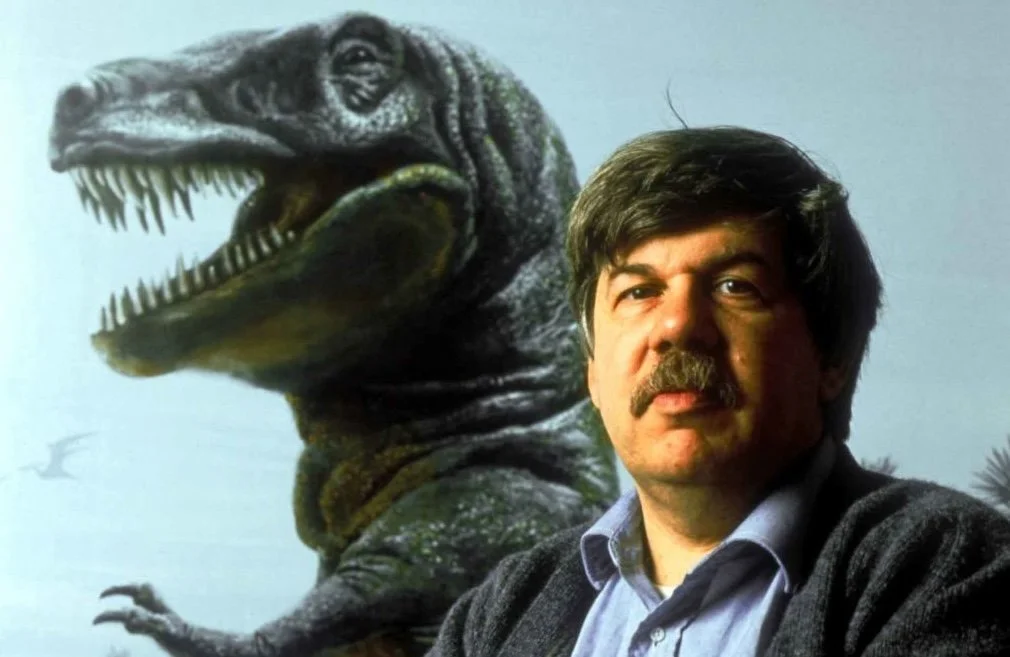
Our guy
The upshot is that the Darwinian bona fides of the Darwinized Gaia hypothesis come down to the issue of creativity. Perhaps the evolution of a potentially-immortal individual can be described in terms of a selection process, but if that process is not a creative one— if it is just passive filtering, as opposed to direction-imparting agency— then it fails the test. This seems to apply to sequential selection and to Doolittle’s model of persistence selection on a single individual; all scope for creativity in these models resides at lower hierarchical levels. However, it does not apply to the model of competing biogeochemical cycles, assuming the assumptions of this model can be made good. (Although I’ve mostly refrained from commenting on this model, this is a nontrivial ask. Certainly it’s still mysterious why selection among competing cycle-variants should produce Gaian outcomes, despite some ingenious speculation (see Boyle et al. 2025).)
* * *
Back in 1998, Tim Lenton remarked that, “when asked to explain how planetary self-regulation could have arise, we are in much the same position as Darwin when asked how the eye could have evolved.” In fact, would-be planetary Darwins were in a rather worse position. In the first half of the nineteenth century, it was at least clear that the eye was an organ of sight, that it had the function of permitting organisms to engage in visual perception. But thirty years later after Lenton’s remark, it remains unclear what, if anything, “Gaia” is. Is Gaia an evolved homeostatic mechanism, a complex adaptive system, or perhaps a waste dump? Is it a mirage? Until this issue is settled, attempts to Darwinize Gaia put the cart in front of the goddess.
Still, it is not an idle mental exercise. Certainly it was important to demonstrate that Gaia does not place impossible demands on the biosphere from the standpoint of evolutionary theory. This kind of Darwinization is a proof of concept for Gaia theory; if Gaia is incompatible with evolutionary theory, if Gaia requires can only exist under conditions that evolutionary theory deems implausible, then we might as well pack it in. However, the current Darwinization project is something else: an attempt to explain how active planetary self-regulation could have evolved by natural selection operating directly on these regulatory properties. Perhaps this will bear fruit. Certainly it has been an interesting development to follow. And yet, as Arthur and Nicholson (2026) observe, “there are now multiple approaches to understanding Gaia,” which draw on bodies of theory ranging from evolution to microbial ecology to thermodynamics. Many models are “much more precisely formulated and thoroughly investigated” than those proposed by the Darwinizers, despite having escaped philosophical notice. And so, these authors urge,
If Gaia theory is to move forward… what is needed are ways to combine these various partial answers, building on and integrating the decades of progress in evolutionary biology, Earth Systems Science, and complexity theory since Lovelock’s original hypothesis. (Arthur and Nicholson 2026)
Darwin may be biology’s patron saint, but when it comes to earth system science (as I said in Part 1), god is in the details.
References
Arthur, R. and Nicholson, A. E. 2022. Selection Principles for Gaia. Journal of Theoretical Biology 533:110940.
Arthur, R. and Nicholson, A. E. 2026. Does Gaia need to Be Darwinized? Philosophy, Theory, and Practice in Biology 17:12. doi: https://doi.org/10.3998/ptpbio.7815.
Beatty, J. 2016. The creativity of natural selection? Part I: Darwin, Darwinism, and the mutationists. Journal of the History of Biology 49. 659–684.
Boyle, R. 2025. Overlapping attempts to falsify and Darwinize the Gaia hypothesis. Philosophical Transactions of the Royal Society, Part B 380:1931. 20240087.
Boyle, R., Moody, E. R. R., Babcock, G., McShea, D. W., Álvarez-Carretero, S., Lenton, T. M. and Donoghue, P. C. J. 2025. Persistence selection between simulated biogeochemical cycle variants for their distinct effects on the earth system. Proceedings of the National Academy of Sciences 122: e2406344122.
Doolittle, W. F. 1981. Is Nature motherly? The Coevolution Quarterly 29:58–63.
Doolittle, W. F. 2017. Darwinizing Gaia. Journal of Theoretical Biology 434. 11–19.
Doolittle, W. F. 2025. Darwinizing Gaia: conceptual approaches. Philosophical Transactions of the Royal Society, Part B 380:1931. 20240089.
Godfrey-Smith. P. 2009. Darwinian Populations and Natural Selection. Oxford: Oxford University Press.
Gould, S. J. 2002. The Structure of Evolutionary Theory. Harvard: The Belknap Press.
Hermida, M. and Okasha, S. 2025. Function, chance and purpose in the biosphere: a critical examination of the Darwinized Gaia hypothesis. Philosophical Transactions of the Royal Society, Part B 380:1931. 20240099.
Kirschner, J. 1989. The Gaia hypothesis: can it be tested? Review of Geophysics 27:223–235.
Lenton, T. M. 1998. Gaia and natural selection. Nature 394:439– 447.
Lenton, T. M. 2025. The evolution of Gaia(s). Philosophical Transactions of the Royal Society, Part B 380:1931. rstb.2024.0095 .
Lenton, T. M., Daines, S. J., Dyke, J. G., Nicholson, A. E., Wilkinson, D. M. and Williams, H. T. P. 2018. Selection for Gaia across multiple scales. Trends in Ecology & Evolution 33: 633–45.
Lewontin, R. C. 1983. The organism and subject and object of evolution. Scientia 77 (18):65
Tyrrell, T. 2013. On Gaia: A Critical Investigation of the Relationship between Life and Earth. Princeton: Princeton University Press.
Tyrrell, T. 2020. Chance played a role in determining whether Earth stayed habitable. Nature Communications Earth and Environment 1:61. doi: https://doi.org/10.1038/s43247-020-00057-8.
Volk, T. 1998. Gaia’s Body: Toward a Physiology of Earth. Cambridge (MA): The MIT Press.